
Scenario-Based Training to Improve Workplace Decisions
 12 minutes





Are your learners forgetting training as quickly as they complete it? Scenario-based training solves this problem by placing learners inside realistic decision-making situations that require active participation and critical thinking. Instead of passively consuming content, learners experience consequences that mirror actual workplace challenges.
Branching scenario software allows you to create learning paths where every choice matters. This guide shows how to design branching scenarios, avoid common mistakes, and develop training that changes behavior.
Key Takeaways
Scenario-based training places learners in realistic job situations where they make decisions and see the results. This article explains how branching scenarios work, why they are effective, and how to design them to create immersive learning experiences.
What Is Scenario-Based Training?
Scenario-based training is an instructional method that uses real-life situations as the foundation for learning. Instead of reading about a policy or procedure, learners are placed in a story where they must solve a problem, handle a conflict, or make a critical choice.
How it differs from traditional “tell-and-test” training
Traditional training methods often follow a linear path: read this, watch this, answer these questions. It’s passive. Scenario-based eLearning is interactive.
A traditional module might list the steps for de-escalating a conflict. A scenario forces the learner to actually de-escalate a conflict with a virtual character. If they say the wrong thing, they see the real-life consequences, like the customer hanging up. This immediate feedback loop is what makes the learning stick.
Scenario-based training can be integrated into conventional eLearning courses or used as stand-alone interactive digital learning.
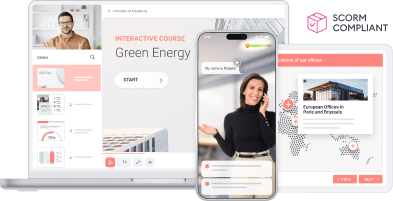
Modern authoring tools such as iSpring Suite make it easy to build these interactive branching scenarios without writing a single line of code.

Why scenarios work so well for adult learners
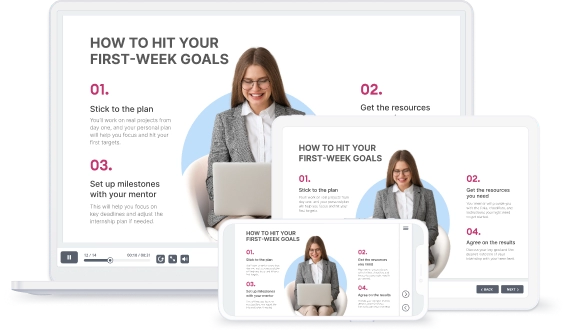
Adults filter out information they deem irrelevant. Scenario-based learning solves this by making the relevance obvious from the first sentence. It’s an active learning strategy that places the learner in a situation they recognize from their daily work life. This makes learners think, “This is about me.” When learners see themselves in the story, they invest emotionally and mentally in finding the appropriate answer.
Core Principles Behind Scenario-Based Learning
To understand why this method is so effective, we need to look at how adults learn differently than children.
Children often learn because they are told to. Their curriculum is standardized, and their life experience is limited.
Adults have existing mental models of how work gets done. They need new information to integrate with what they already know. This is why real-life situations matter. Scenario-based learning anchors new concepts in contexts adults already recognize. It is active learning instead of passive listening.
Andragogy: the foundation of scenario-based learning
Malcolm Knowles popularized the theory of andragogy, which outlines the unique needs of adult learners. Adults are self-directed. They need to know why they are learning something before they invest time in it.
Scenario-based learning aligns perfectly with this because it immediately answers the “what’s in it for me?” question by placing the learner in a context they value.
Effective scenarios are built on a cycle. Learners draw on their experiences to make a choice. They see the outcome of that choice. Then, ideally, they are given time to reflect on why that outcome occurred. This cycle of action and reflection is what builds deep understanding rather than surface-level recall.
Adults are motivated to learn when they see that it will help them solve a real problem. A compliance course is boring until it becomes a scenario about a data breach that could actually happen in their department. The motivation shifts from “I have to finish this” to “I need to know how to handle this.”
Types of Scenario-Based Learning
Scenarios come in many shapes and sizes, from simple quizzes to complex, immersive worlds.
- Linear scenarios and branching scenarios
A linear scenario presents a story, asks a question, and then moves on regardless of the answer. It is a slight improvement over a quiz. Branching scenarios are dynamic. The learner’s path changes based on their input. A wrong decision might lead to a remedial branch where they have to fix their mistake, while a correct one advances the plot. This model engages learners and holds them accountable for the outcome. - Simulations, role-plays, and serious games
Simulations are high-fidelity replicas of a task, like practicing a software update in a sandbox environment. Role-plays often focus on dialogue and soft skills, allowing learners to practice difficult conversations. Serious games take this further by designing the entire learning experience as a structured game, with rules, objectives, challenges, and feedback, where learning outcomes are embedded directly into gameplay. - Micro-scenarios for just-in-time performance support
Not every scenario needs to be 30 minutes long. Micro-scenarios are short, focused challenges embedded in the workflow. Imagine a salesperson about to send a tricky email. A pop-up scenario could quiz them on the right tone to use, right there in the moment. This provides immediate feedback when they need it most. - Social and collaborative scenarios
Scenarios don’t have to be completed alone. In a virtual classroom or live workshop, teams can be given a problem to solve together. This introduces social learning dynamics, in which learners debate the merits of different choices and learn from each other’s reasoning.
When to Use Scenario-Based Learning and When Not To
It’s a powerful tool, but it is not the right tool for every job.
Scenario-based learning excels when the goal is to improve judgment, soft skills, or decision-making under pressure.
It’s ideal for:
- Leadership development: Navigating team conflicts and coaching moments.
- Compliance: Moving beyond policy acknowledgment to ethical application.
- Customer service: Practicing tone and de-escalation techniques.
- Healthcare: Clinical diagnosis and emergency response.
- Technical training: Troubleshooting equipment failures safely.
When to choose scenarios over lectures
Lectures are good for broadcasting information. Scenarios are good for changing behavior.
If your online training needs learners to analyze, evaluate, or create, scenarios are your best option. They are particularly effective for tackling nuanced topics where there is no single correct answer, such as ethics or diversity.
Situations where scenarios are the wrong choice
If you simply need to communicate a new data privacy regulation or a simple product fact, a scenario is unnecessary. When the learning objective is pure recall, such as memorizing a formula or a list of terms, a straightforward knowledge check is more efficient.
Avoid scenarios if you don’t have a clear understanding of the real-world context or the common mistakes learners make.

Designing Effective Scenario-Based Learning Step by Step
Creating a great scenario requires a structured approach.
Step 1: Clarify business goals and performance outcomes
Start with the gap. What are people doing wrong? What does success look like on the job? Define the measurable outcome before you write a single word of dialogue.
Step 2: Analyze your learners and real-world context
Talk to your learners and subject matter experts. You need to know the language they use, the pressure points they feel, and the tools they have. A realistic scenario is built on the small details that insiders recognize.
Step 3: Choose the right scenario format
How complex does it need to be? A simple multiple-choice question with different feedback for each answer might be enough. Or you might need a full video-based branching scenario with professional actors. Match the complexity to the risk of the task.
Step 4: Map decisions, consequences, and feedback
This is the technical backbone. Use a flowchart to map out every decision point. For each choice, define the consequences. Crucially, define the feedback. Learners need to understand why a choice led to a specific outcome.
Step 5: Write realistic stories, characters, and dialogue
Ground your story in reality. Give the characters names and motivations. The dialogue should seem like conversations between real people. The conflict should be a recognizable pain point for your audience.
Step 6: Add reflection and transfer activities
Incorporate moments for reflection. Ask the learner, “Why did you choose that option?” or “What would you do differently next time?” This solidifies learning and prepares them to transfer the new knowledge back to the job.
Step 7: Pilot, measure, and iterate your scenarios
Test your scenario with a small group of your target audience. Note where they get stuck or confused. Use that data to fix the flow before you roll it out to the entire organization.
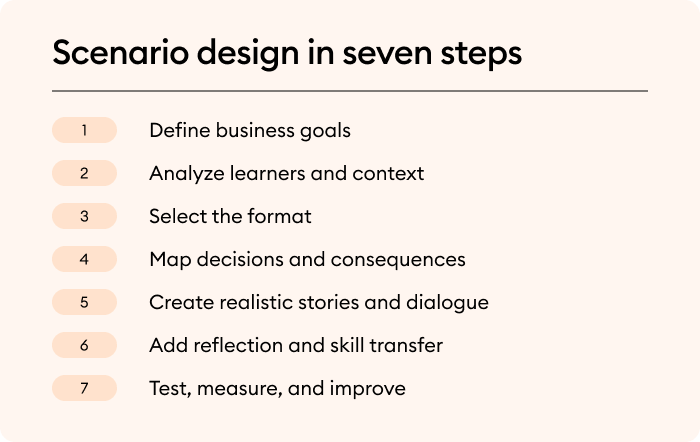
Seven steps to design effective scenario-based training
Too much to read? Get a summary from AI
Scenario-Based Learning in Different Contexts
Industries from healthcare to law enforcement use scenario-based learning to prepare employees for high-stakes situations.
- Corporate training: Turn compliance into ethical dilemmas. Learners see the impact of data mistakes safely. This builds a stronger security culture and sharpens critical thinking.
- Customer education: Place new users in a simulated project where they must use key features to succeed. This reduces the learning curve through active learning.
- Healthcare: Nurses practice rare emergencies without risking lives. Realistic scenarios prepare them for high-pressure moments.
- Technical and operations: Let operators troubleshoot equipment failures in virtual reality before touching expensive machinery. They explore consequences without real-world risk.
- Higher education: Business students run simulated companies. Public health students manage disease outbreaks.
These examples show that scenario-based eLearning builds practical skills across every role. When you design scenarios that mirror actual work, learners stay engaged and retain more.
Measuring the Impact of Scenario-Based Learning
How do you know if it worked?
1. Define success metrics before you design
Define success early. Are you trying to reduce support tickets? Increase sales close rates? Decrease safety incidents? Your scenario should be designed to impact that specific metric.
2. Track decisions, errors, and confidence shifts
Look at the data. Are 80% of your managers choosing the “avoidance” option in a conflict scenario? That tells you where the real training gap is. This data is more valuable than a test score.
3. Link scenario performance to on-the-job outcomes
Link performance in the scenario with actual performance reviews or KPIs. If people who pass the scenario have fewer customer complaints, you have proven the ROI.
4. Use data to refine and personalize scenarios
Use the resulting data to fix confusing branches or build new scenarios targeting the most frequent mistakes.
Tips for Writing Effective Branching Scenarios
Use these practical tips when you write scenarios for online training:
Tip 1: Make characters believable
Give the angry customer a genuine reason to be upset. Let the frustrated manager show vulnerability. When characters feel real, the learning sticks.
Tip 2: Add realistic pressure
Work happens under deadlines. Add a timer to a sales negotiation. Limit the information available to mimic real-world ambiguity. This forces critical thinking instead of hunting for the one right answer.
Tip 3: Let learners fail safely
Challenges should feel tough, but consequences should not. Learners need to feel free to fail without real consequences. Failure is how they remember what to avoid doing.
Tip 4: Give them meaningful choices
Don’t force a choice between obviously correct and obviously incorrect. Present two options that both seem plausible. Let the learners weigh the options. That’s where real learning happens.
Use this checklist before you start:
- Is the problem rooted in an actual workplace issue?
- Does the learner have enough context to make an informed choice?
- Are the consequences of each choice logical and instructive?
- Does the feedback explain the “why”?
- Is there an opportunity for reflection?
A template to map your scenario
Start with a whiteboard or a simple flowchart tool. Write the initial scene in a box. For every decision point, draw a branch to a new box that represents the outcome.
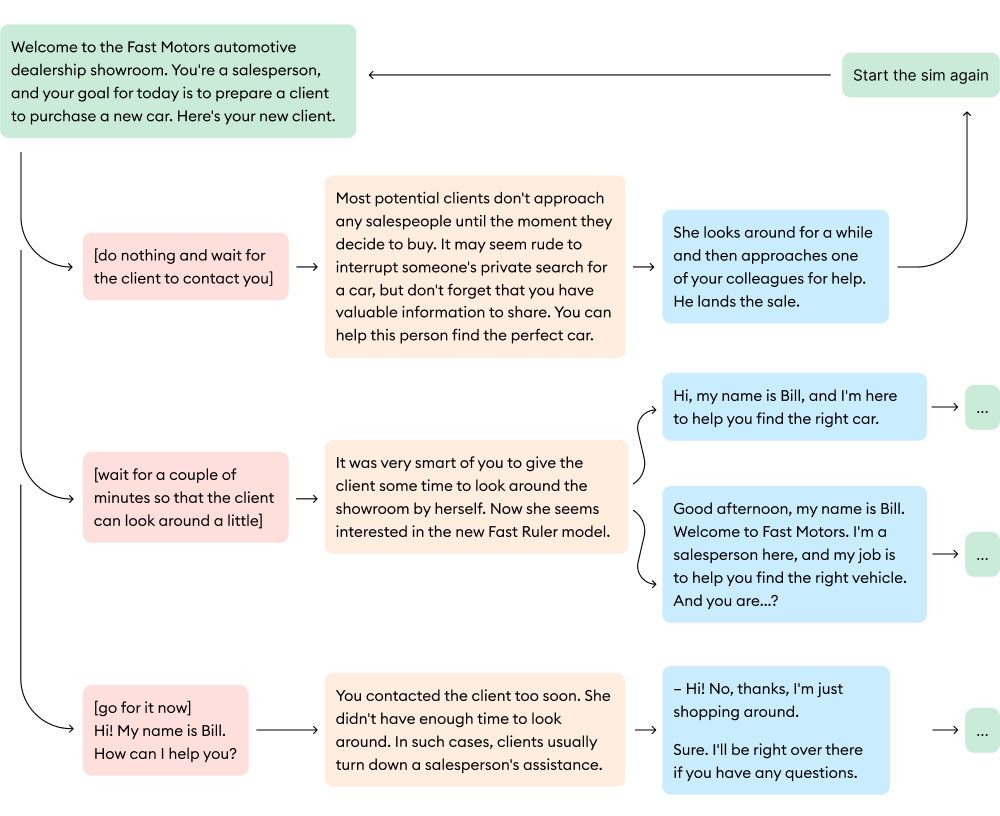
Example of a branching scenario flow
Common Pitfalls in Scenario-Based Training and How to Avoid Them
| Overly long, complex, or confusing storylines | If the learner is confused about the plot, they aren’t learning the skill. Keep the story simple enough to be a vehicle for the decision, not a distraction from it. |
| Unrealistic situations that undermine credibility | If a sales scenario has a customer acting in a way that no actual customer ever would, the learner will dismiss the entire exercise. Always validate your stories with real-world practitioners. |
| Focusing on trivia instead of critical decisions | Don’t test them on the color of the logo. Test them on the decision that matters. Every branch should serve a learning objective related to the core performance goal. |
| Ignoring feedback, reflection, and debrief | If a learner makes a mistake and you just show them an “incorrect” screen, you’ve wasted the opportunity. The feedback is where the learning happens. Explain the “why.” |
Getting Started with Scenario-Based Learning
You don’t have to build a Hollywood production overnight.
- Start small: pilot one high-value scenario
Pick one high-impact area. One conversation. One process. Build a simple prototype and test it. Prove the concept before you scale. - Involve stakeholders, SMEs, and learners in co-creation
This can’t be built in a vacuum. You need the experts to tell you the stories and the learners to test the realism. Involve them early. - Create a roadmap to scale scenario-based learning
Once you have a successful pilot, build a template. Standardize your process so you can replicate it across the organization. Identify the tools you need to scale efficiently.
When you replace bullet points with decisions, you replace passive readers with active learners. Scenario-based training is the most direct path from knowing what to do to actually doing it. It respects the learner’s intelligence, mirrors the complexity of the real world, and delivers the kind of behavioral change that corporate training leaders are held accountable for.
You don’t need to be a programmer to create scenario-based learning. Start your free trial of iSpring Suite and make your first interactive scenario today.
Create online courses and assessments in record time.



The 10 Best Test Makers for Teachers in 2026

9 eLearning Content Types to Include in Your Training Program

13 Customer Service Role-Play Scenarios: (+Scripts to Master)

26 Remote Work Tools & Software You Need to Check Out