
The 10 best AI tools for teachers: a practical comparison
 23 minutes






Most AI tools for teachers fit into work that is already happening. A teacher might have a PowerPoint deck, last year’s reading, and half a lesson plan — not a blank page waiting for artificial intelligence to fill it.
These tools are not interchangeable. Some quickly turn a source into questions or rewrite it at several reading levels. Others are meant for building and delivering a complete online unit. We compare the work that each one removes — and the necessary editing, setup, and privacy review it subsequently requires.
Key takeaways
This guide compares 10 AI tools for teachers, covering lesson planning, differentiated instruction, assessment, feedback, research, and full online courses. The focus is K–12, but several tools also suit college teaching, instructional design, and staff training.
A quick comparison of AI tools for teachers
| Tool | Best for | What sets it apart | School system fit | Main tradeoff |
| iSpring Suite AI | Complete online course production | Turns PowerPoint and source files into courses with quizzes, narration, and branching | Publishes to an LMS through SCORM, xAPI, AICC, or cmi5 | Desktop authoring requires Windows and PowerPoint |
| MagicSchool AI | Everyday K–12 planning | More than 80 task-specific tools plus an open-ended assistant | Google Classroom and Google/Microsoft sign-in are available across plans; Canvas, Schoology, Clever, and ClassLink integrations require the Enterprise plan | The large tool library can feel overwhelming |
| Wayground | Quiz-based checks and review | Creates interactive quizzes from files, links, videos, or worksheet photos | MS Teams class import; grade sync on School/District plans | Generated questions still need review |
| ChatGPT | Flexible planning and revision | Refines related materials through an ongoing conversation | No built-in rostering, assignment delivery, or grade sync | Facts and citations require checking |
| Eduaide.ai | Structured lesson resources | Guided tools for planning and assessment tools | Exports to Google Docs, Forms, Word, PDF, and text | Creates materials but does not deliver them |
| Brisk Teaching | In-browser creation and feedback | Makes guided notes and places teacher-approved comments inside documents | Works across Google, Microsoft, and supported LMS pages | Requires Chrome or Edge |
| Diffit | Differentiated reading materials | Produces up to five reading levels with questions and answer keys | Print and PDF output; Google and Microsoft exports on paid plans | Reading levels remain estimates |
| Khanmigo | Guided math and science practice | Uses questions and hints with equations, graphs, and handwritten work | Runs inside Khan Academy; district rostering through Clever or ClassLink | Classroom access requires a school or district implementation; parents can separately enable Khanmigo for up to 10 children through an eligible parent subscription |
| Canva Magic Write | Visual classroom materials | Keeps writing and design in the same workspace | Connects with Teams, Google Classroom, Canvas, and Schoology | Generated information may be dated or inaccurate |
| Gemini Notebook | Source-grounded unit planning | Links incorrect and correct answers back to materials selected by the teacher | Syncs with Google Drive; no assignment or grade management | Source grounding does not guarantee accuracy |
Selection criteria: features, free tier, and data privacy
A free plan may seem generous when it is used for one worksheet. The limits become clearer when a teacher needs several reading levels, questions, and materials for multiple classes before the school day begins. These are rarely one-off tasks.
We counted that extra work when comparing these AI tools for teachers. Integration mattered as well: exporting a file is not the same as placing a usable assignment in the school’s platform. We also looked at free-plan limits with a full teaching schedule in mind.
For privacy, we checked the vendor’s published position on student data, AI model training, FERPA, COPPA, and GDPR. We also looked for school agreements such as a DPA or SDPA. These statements describe what vendors publish; they do not replace a district’s own legal and security review.
How we reviewed the tools: This is a documentation-based comparison, not a claim of hands-on classroom testing. We reviewed official feature pages, help centers, pricing information, and privacy terms using the same criteria for all 10 products. Product details and prices were last checked in October 2026, and may change.
Disclosure: iSpring publishes this article and develops one of the products included in the comparison. Its product was assessed against the same published criteria used for every other tool.
The Top 10 AI tools for teachers
1. iSpring Suite AI
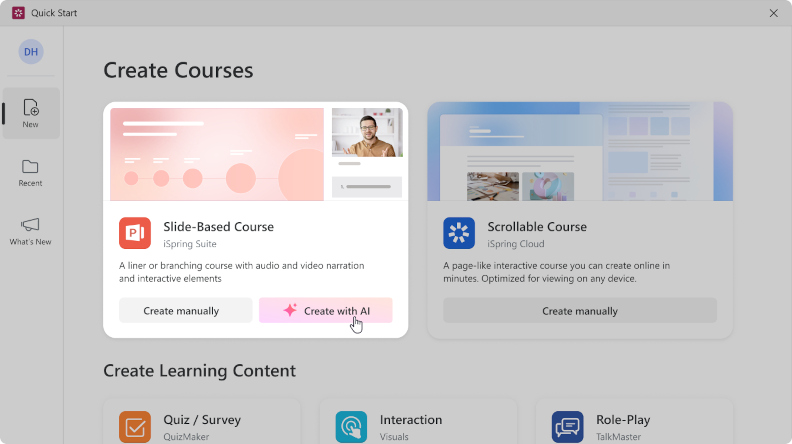
For teachers who already have a PowerPoint deck, iSpring Suite AI is a great way to move to a more powerful tool without extra training. You can keep working in PowerPoint while adding the assets that a regular presentation lacks: narration, quizzes, branching activities, role-plays, and courses that a compatible LMS can track.
Its AI Course Creator can draft a course from source files or a prompt, including the structure, lesson text, activities, and assessment questions. Cloud AI, included with the subscription, supports scrollable courses and browser-based review.
Best for
Taking a course from its first draft through review and LMS delivery without piecing together several authoring tools.
Pros
- Builds on PowerPoint files that teachers may already have.
- Covers advanced course creation capabilities right in PowerPoint.
Publishes to SCORM, AICC, xAPI, cmi5, HTML5, and MP4.
Offers one-click publishing to iSpring LMS and browser-based review through Cloud AI.
Cons
- Requires Windows and desktop PowerPoint.
Pricing
$1,290 per author per year. Academic pricing is available upon request. A 14-day trial is available.

2. MagicSchool AI
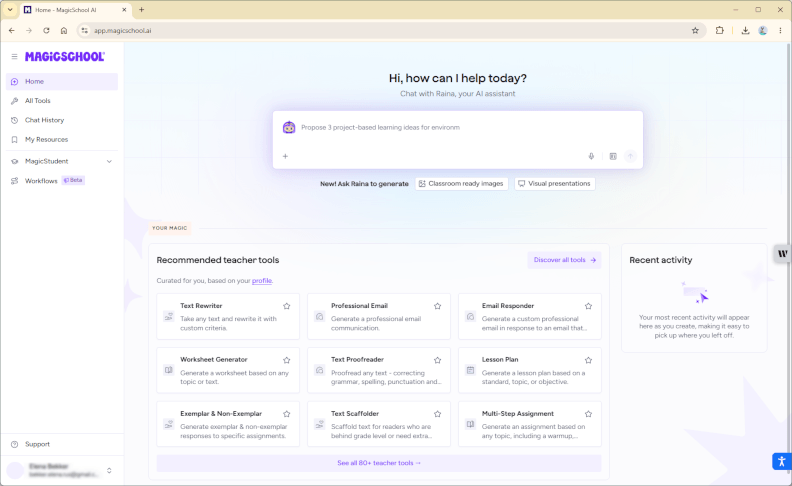
This comprehensive AI-powered platform offers more than 80 teacher tools, along with the Raina chatbot for less structured requests. Recent additions include content generators. The number of choices can feel like a lot at first, but the new tools are grouped by the task they handle.
Best for
Preparing a week’s classroom materials without moving between a collection of separate generators.
Pros
- Designed around common K–12 teaching tasks.
- Creates presentations that can be exported to Google Slides or PowerPoint.
- Includes teacher oversight and safety controls for student-facing AI.
Cons
- The free plan limits generations, output history, and editing.
- Canvas, Schoology, Clever, and ClassLink integrations require the Enterprise plan.
- Microsoft support covers sign-in and exports, but MagicSchool does not list a direct Microsoft Teams assignment integration.
Pricing
The Free plan is available to individual teachers. Plus costs $8.33 per user per month with annual billing or $12.99 per month. Enterprise pricing is custom.
3. Wayground
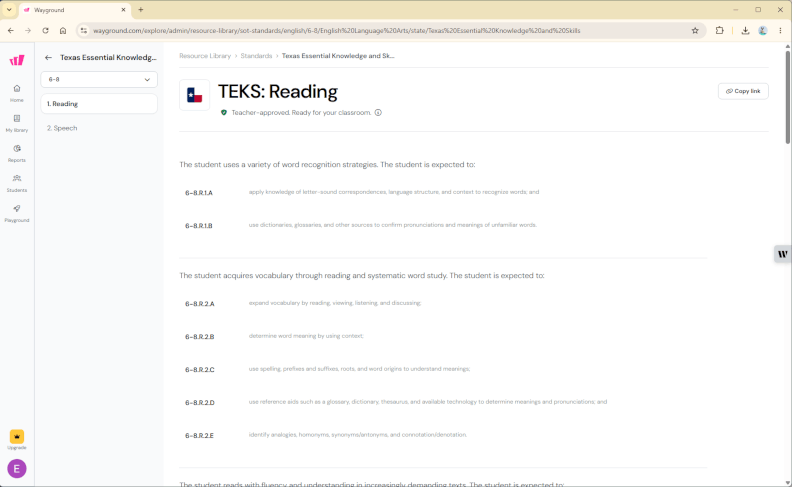
Wayground, formerly Quizizz, is made for a familiar classroom job: turning material you already have into a quick check for understanding. Upload a document or lesson prep, slide deck, or YouTube link, and its AI question generator will draft a quiz. You can set the grade, subject area, standards, and question count, then edit the result before students see it.
Teachers can create lessons, flashcards, passages, and interactive videos, then run them live or assign them for later. Its game modes add some energy to review sessions without requiring teachers to build a game from scratch.
Best for
Running a fast check for understanding, either live or as independent practice.
Pros
- Creates questions from PDFs, presentations, documents, websites, videos, and worksheet photos.
- Supports live games, word clouds, and self-paced assignments, with accommodations and performance reports.
- School accounts include LMS rostering and grade sync. Microsoft Teams integration lets teachers import classes and channels.
Cons
- The standard Starter plan limits storage and some premium capabilities; AI availability can vary by account and region. Former Free-for-Schools accounts transitioned to Starter with unlimited AI in September 2026.
- Only the first 16,000 characters of an uploaded file are processed.
- AI-generated questions can contain mistakes and need a teacher’s review.
Pricing
The Starter plan is free and allows up to 20 stored activities, with limited AI use and basic question types. The Individual plan is listed at $18 per month for U.S. users when billed annually and includes a seven-day trial. School and district pricing is available upon request.
Too much to read? Get a summary from AI
4. ChatGPT
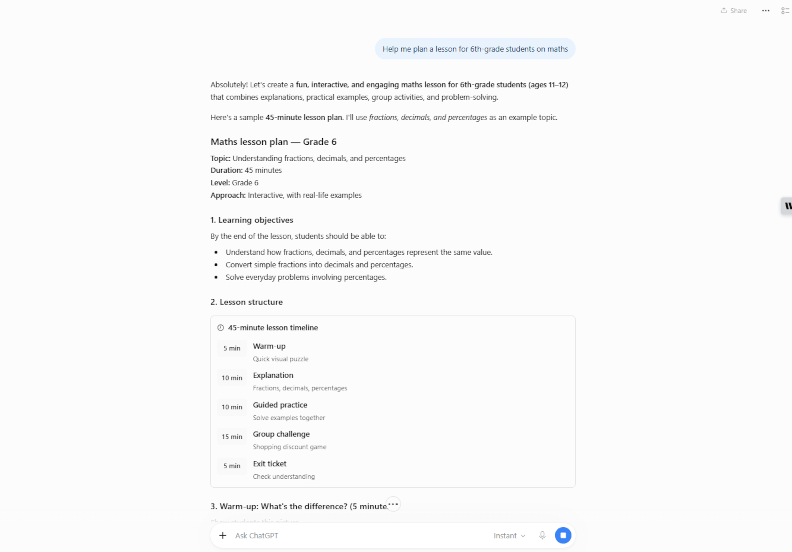
OpenAI’s ChatGPT is less like a menu of teacher tools and more like a working conversation. A teacher can bring in standards, old lesson files, or a rough unit outline and ask for a plan, slide deck, handout, or activity. OpenAI’s education resources include practical workflows for each job, making ChatGPT one of the more flexible AI tools for lesson planning.
A teacher can then ask for smaller changes. None of those revisions removes the need for review. Accuracy, citations, standards, and answers remain the teacher’s responsibility.
Best for
Working through teaching tasks that do not fit neatly into a preset generator.
Pros
- Handles a much wider range of teaching tasks than a dedicated quiz or worksheet generator.
- Can work from uploaded files, rough notes, and web sources.
- Makes it easy to revise one part of a lesson or create several related materials from the same source.
Cons
- Does not provide the class rostering, assignment delivery, or grade syncing of an LMS.
- Can produce incorrect facts, invented citations, or unsuitable examples with a confident tone.
- Free-plan usage limits vary with the feature and model being used.
Pricing
ChatGPT has a free plan with usage limits. ChatGPT Plus costs $20 per month and provides higher limits and access to additional features. Pricing for managed education and enterprise workspaces is available through sales. ChatGPT for Teachers is free through June 2028 for verified U.S. K–12 educators. It provides a managed workspace with education-focused privacy and admin controls and is not currently intended for students.
5. Eduaide.ai
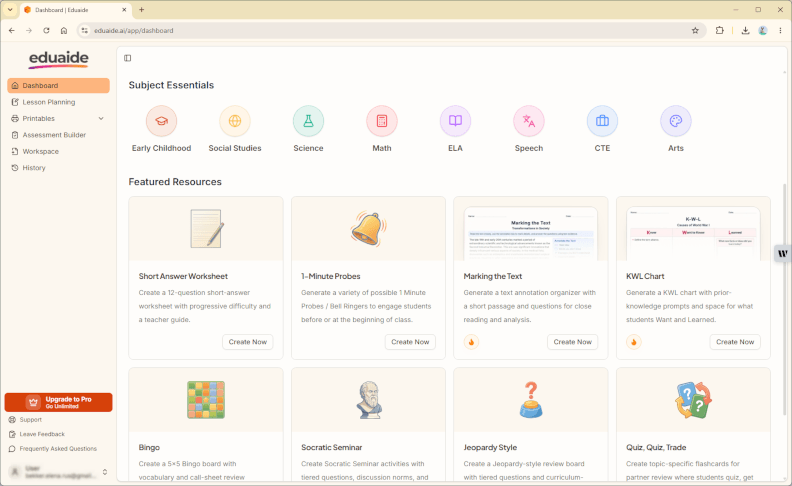
Eduaide.ai replaces the blank chat box with specific teaching tasks. Choose a lesson format, rubric, discussion routine, assessment, organizer, or classroom game. The result opens as an editable document rather than disappearing into a long chat.
Eduaide can check reading level, vocabulary, sentence structure, and assumed background knowledge. Erasmus, its document assistant, handles less predictable edits without moving the written work into another tool.
Best for
Creating structured classroom materials without having to write elaborate AI prompts.
Pros
- Includes 81 purpose-built tools for planning, assessment, discussion, differentiation, and classroom communication.
- Builds assessments from configurable sections, question types, point values, and difficulty levels.
- Exports to Google Docs, Google Forms, Word, PDF, and plain text.
Cons
- It creates materials but does not deliver lessons, roster students, or sync grades.
- No direct Microsoft Teams integration is listed; materials must be exported or pasted into the school’s LMS.
- Differentiation, Erasmus document chat, image generation, and longer source inputs require Pro.
Pricing
The Free plan has generation limits. Eduaide currently lists 24 generation credits per month for its lesson-planning workflow; a lesson or unit plan uses three credits. The published annual price is $49.99, or $4.17/month, billed annually.
6. Brisk Teaching
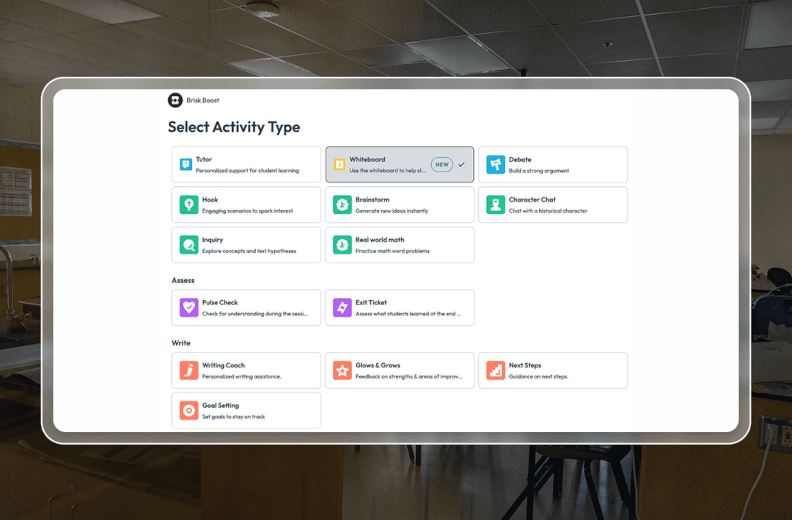
A teacher can be halfway through an article or video and open Brisk Teaching without leaving the page. The Chrome extension reads the open source and can build slides, comprehension questions, or guided notes around it. It also works across common Google and Microsoft files and supported LMS pages.
The same setup carries over to grading rubrics. In a Google Doc, Brisk suggests personalized feedback beside the passage it refers to. Those comments remain private until the teacher checks and posts them. With the Canvas integration, Brisk can read an attached rubric and transfer scores to SpeedGrader.
Best for
Creating materials and responding to student work without leaving the browser tab already open.
Pros
- Works directly inside documents, videos, webpages, and common LMSs.
- Creates guided notes and other resources from the material that’s open.
- Keeps inline comments in draft form until the teacher approves them.
- Supports Google and Microsoft teaching workflows.
Cons
- The extension only supports Chrome and Edge.
- Several standout features, including unlimited use and advanced feedback workflows, require a paid plan.
- Feedback and generated materials still need to be checked for accuracy and fit.
Pricing
The Free Forever plan includes more than 20 tools. New accounts receive a 14-day Premium trial before moving to the free version. Educator Pro adds unlimited use. Its current price is shown inside the extension rather than on Brisk’s public pricing page.
7. Diffit — Differentiation and Multiple Choice
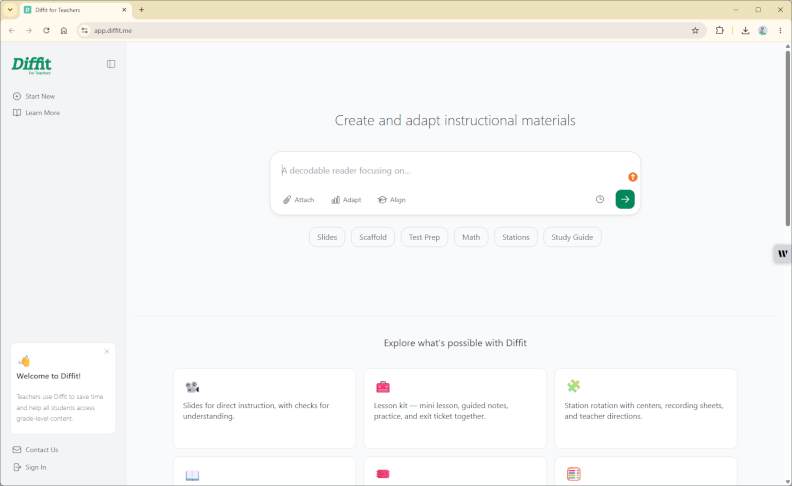
Diffit is useful when the class needs the same material at more than one reading level. It turns source materials into leveled readings and classroom pages with vocabulary support, guided notes, graphic organizers, and other activities. A resource can include up to five reading levels.
Multiple-choice questions appear alongside the reading. Diffit can also add short-answer questions and a teacher answer key. With the Premium plan, teachers can align questions to standards, general literacy skills, or Depth of Knowledge (DOK) levels.
Best for
Making existing curriculum material more accessible without rewriting every version by hand.
Pros
- Creates five reading levels from the same material.
- Generates multiple-choice and short-answer questions with an answer key.
- Produces printable worksheets, vocabulary support, notes, and graphic organizers.
Cons
- Reading levels are estimates, so teachers still need to check the vocabulary and subject content.
- Standards alignment, advanced customization, and Google or Microsoft exports require the Premium plan.
Pricing
The Basic plan is completely free for teachers and includes resource creation, editing, PDF downloads, printing, and sharing. Free accounts keep only the previous 90 days of resources. Individual Premium costs $14.99 per month or $149.99 per year and adds standards alignment, advanced controls, full resource history, graphic organizers, and Google and Microsoft exports. School pricing depends on enrollment and is available upon request.
8. Khanmigo
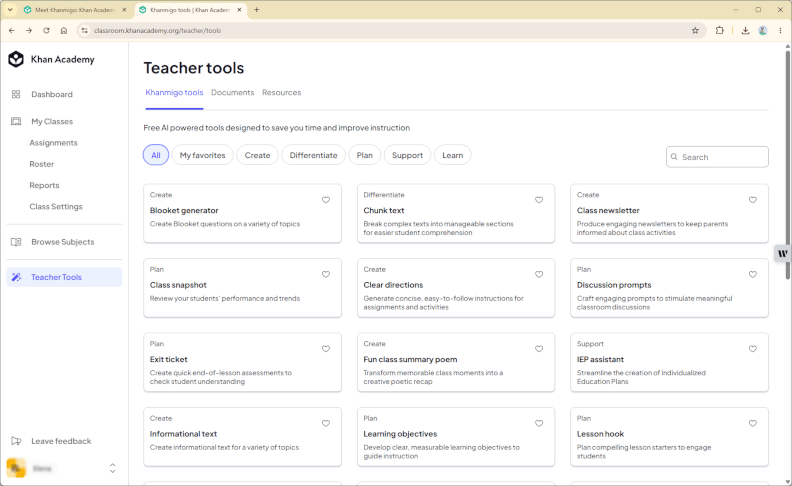
The difference with Khanmigo shows up when a student says, “I don’t know what to do next.” Instead of supplying the answer, it tries another question or a smaller hint. Students can open it while they are working through Khan Academy material, so the conversation already has some context.
The dedicated math and science tutor is useful for checking steps in an equation, interpreting a graph or geometry diagram, reviewing scientific vocabulary, and talking through concepts in biology, chemistry, or physics.
Best for
Helping students work through a math problem without simply giving them the answer.
Pros
- Uses questions and hints to keep the student involved in solving the problem.
- Works alongside Khan Academy exercises, videos, and articles.
- Accepts equations, handwritten work, graphs, and science diagrams.
- Lets teachers and parents review student conversations and receive alerts about flagged content.
Cons
- Like any AI tutor, it can misunderstand a question or give incorrect information.
- Khan Academy places daily limits on AI conversations.
Pricing
Khanmigo Teacher Tools are free for eligible educators, but this plan does not include the student tutor. Individual learner and parent subscriptions cost $4 per month or $44 per year; a parent plan can cover up to 10 children. For schools with up to 1,000 students, Enterprise Starter costs $10 per student per year. Larger districts receive custom pricing.
9. Canva Magic Write
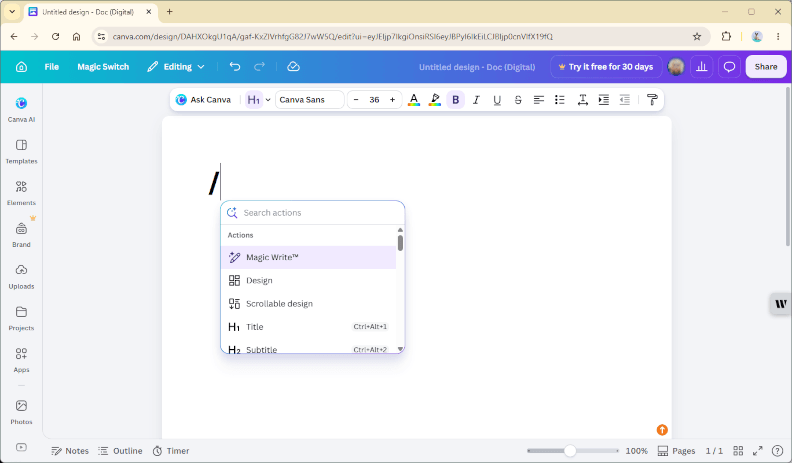
This part of Canva’s Magic Studio creates and revises copy inside the same workspace used to design worksheets, slides, and classroom visuals.
Canva Magic Write can inspire your creativity by providing ideas, structure, and educational content to make your lessons more engaging and impactful for your students. The potential and limitations of this program come down to how often you can find a use for it and how satisfied you are with the content it creates.
Best for
Getting past the blank page when a handout, slide deck, or classroom visual still needs words.
Pros
- Combines writing and design in a single workspace.
- Supports brainstorming, outlines, lists, summaries, and rewriting.
- Supports more than 100 languages, according to Canva’s Help Center.
- Connects with Microsoft Teams, Google Classroom, Canvas, and Schoology.
Cons
- Canva says its knowledge only extends to mid-2021.
- The output may be inaccurate or repetitive.
Inputs are limited to 1,500 words, with outputs of around 2,000 words.
Pricing
Canva for Education is free for eligible K–12 users. Magic Write is disabled by default on Education accounts, and administrators or teachers control access to Magic features.
10. Gemini Notebook
Image alt=Gemini Notebook for teachers
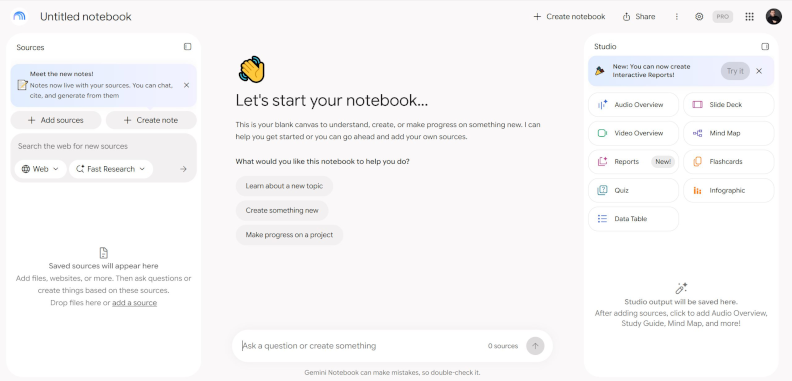
Most unit planning begins with a mess: the district standards PDF, two readings in Drive, last year’s slides, and a video you saved but never filed. Gemini Notebook brings those sources into a single workspace and keeps its responses tied to them. Responses include citations linked to the original passages, making it easier to check where an idea came from.
Best for
Reusing one set of sources to create lesson ideas, study guides, quizzes, and other supporting materials.
Pros
- Grounds chat responses in teacher-selected sources and provides inline source citations; quizzes and flashcards can also be generated from those sources.
- Accepts PDFs, websites, Google files, Microsoft files, images, audio, and public YouTube videos.
- Can turn the same unit materials into study guides, progress reports, mind maps, quizzes, flashcards, slide decks, and audio or video overviews.
Cons
- Does not guarantee factual or instructional accuracy.
- It is a planning and research workspace, not an LMS.
- Gemini Notebook uses compute-based AI quotas that depend on prompt complexity, models, features, and chat length.
Pricing
Gemini Notebook Standard is free and includes 100 notebooks with up to 50 sources in each. An individual source can contain up to 500,000 words or be as large as 200 MB.
Google AI Plus costs $9.99 per month in the US and raises the limits to 200 notebooks and 100 sources per notebook. Google AI Pro costs $19.99 per month and allows 500 notebooks and 300 sources per notebook. Workspace for Education limits depend on the school’s Google Workspace edition.
Safety and compliance: Are AI tools safe for classrooms?
For schools, “safe” means more than secure passwords. The tool should limit how it collects, stores, shares, and uses student information.
- FERPA protects student education records in the United States.
- COPPA covers the online collection of personal information from children under 13.
- GDPR governs the use of personal data in the European Union.
This table reflects each vendor’s published position, not an independent guarantee that a tool is approved for every school.
| Tools | Published privacy position | AI training |
| MagicSchool, Wayground, Brisk, and Canva Education | State that their education services meet FERPA, COPPA, and GDPR requirements. | Each vendor publishes no-training commitments for education/student data, but the exact scope differs by service and account type. |
| Gemini Notebook | Google documents FERPA, COPPA, and GDPR protections for school-managed Workspace for Education accounts. | School data is not used for model training. |
| Eduaide | States that it follows FERPA and COPPA and publishes terms for GDPR users. | Eduaide is a teacher-facing service, does not request or collect student data, and does not permit users under 18. Eduaide says OpenAI and Anthropic may not use its API inputs or outputs for model training; provider-side abuse-monitoring retention of up to 30 days may apply. |
| Diffit and Khanmigo | Both address FERPA and COPPA; neither makes a separate product-specific GDPR claim. | Diffit says it collects no student data. Khan Academy prohibits AI providers from training on school inputs. |
| ChatGPT | Schools should confirm FERPA, COPPA, and GDPR terms in their ChatGPT Edu agreement. | Personal Free/Plus content may be used to improve models unless the user opts out; ChatGPT for Teachers, Business, Enterprise, and Edu workspace content is not used for training by default. |
| iSpring Suite AI | Publishes GDPR safeguards but makes no specific FERPA or COPPA claim for its AI tools. | No public no-training promise; student PII should not be entered in prompts. |
Before approving any tool, however, the school should request its DPA, SDPA, or NDPA. The agreement should cover data deletion, retention, subprocessors, breach notification, and AI training — not simply refer to a general privacy policy.
How to choose based on your workflow: which option fits your organization
Start with the work that takes up teachers’ time, then consider where that work needs to live. A useful tool should fit the school’s existing accounts, devices, and delivery system.
For organization-wide course production
iSpring Suite AI fits schools and larger teams producing complete online courses rather than occasional worksheets. It turns existing PowerPoint material into courses with quizzes, narration, role-plays, and learner tracking. Courses can be published to an LMS in SCORM, AICC, xAPI, or cmi5 format.
For everyday planning
MagicSchool is better suited to the stream of smaller jobs that fill a teacher’s week: generate lesson plans, worksheets, assessments, routine student writing, and exit tickets. Diffit or Wayground may be sufficient when the job is even narrower — one reading to adapt or one quiz to make.
For Google or Microsoft schools
Brisk Teaching suits classroom teachers who already spend much of the day in Google Docs and Google Classroom. Its browser extension can create materials and place feedback directly in a student’s document.
Whatever the platform, check what its LMS integration really handles. A connection that still leaves teachers rebuilding assignments or entering grades by hand will not save much time.
For assessment and multiple-choice work
For a large exam, Wayground works well when the entire class needs the same quiz. It can build multiple-choice questions from existing material, run the activity live, or assign it for later, score responses, and show where students struggled. Diffit is the better fit for a smaller formative check built specifically around leveled reading material.
Implementation checklist for districts and teachers
A polished demo does not show what happens when 40 teachers, several reviewers, and an LMS enter the picture. Run a small pilot through the same conditions the school will use later.
Test a complete course
Run the pilot the way a real course would run. Give the author, reviewer, and administrator separate accounts, then build a short course from an existing PowerPoint or PDF. Use made-up learner records, add narration, an interaction, and a quiz for greater student engagement. Then publish to a test LMS. Check that completions and scores come back correctly. Also confirm the hardware early: slide authoring requires Windows and desktop PowerPoint, whereas reviewers can work in a browser.
Review the paperwork
A useful privacy review leaves the district with documents it can return to later. That means a signed DPA or SDPA, the current list of subprocessors, firm retention and deletion terms, a breach-notification process, and a plain answer about AI training. Add the vendor’s latest SOC 2 report or other independent security assessment when available. If the important promises exist only on a webpage the vendor can change, the review is not finished.
Check access and provisioning
Test SSO with both teacher and student accounts. The simplest check is to follow one dummy student. The student signs in, joins the correct class, completes the work, and appears in the LMS report under the right name. Repeat the process with a teacher account.
Give teachers a workable starting point
Give course authors a small project and enough time to finish it properly. They should build the lesson, have someone review it, and publish it to the test LMS. For Brisk, a district-wide feature tour is unnecessary. Start with inline feedback or guided class notes and let teachers check every result before using it with a class.
A worksheet tool may be enough for tomorrow’s class. A district-wide course is different: several people may review it, the LMS must record progress, and existing PowerPoint material should not have to be rebuilt. A more substantial authoring platform can be worth the learning curve here.
Final notes and next steps
A small pilot should answer a plain question: did the tool provide any time savings once the teacher checked and finished the work? Use familiar material and keep student information out of the test. Pay attention to corrections, awkward exports, and any steps that still have to be executed manually.
Keep a short record of the privacy terms behind the decision on AI tools for teachers. If the district needs full online units rather than separate worksheets, the next useful test is to start for free today with a familiar presentation with iSpring Suite AI.
Start with a PowerPoint lesson you already use. Add quiz questions, narration, and interactions with iSpring Suite AI.
Create online courses and assessments in record time.





The 10 Best Test Makers for Teachers in 2026

The 8 Best Online Plagiarism Checkers for Teachers and Students

Practical AI Prompts for Instructional Designers

How Much Does It Cost to Develop an Online Course in 2026?

 AI
AI