7 strategies to beat the forgetting curve
 11 minutes


Learning something new doesn’t guarantee that you’ll remember it later. An employee may learn how to reopen an order, only to forget the steps by the time they need them.
That’s the forgetting curve at work. In this article, we’ll cover seven practical ways to mitigate it and help learners retain and apply new knowledge.
Key takeaways
To counter the forgetting curve and help learners retain information longer, build opportunities for practice and review into the training process. Use immediate application after the demo. Let your learners try a task they’ll do at work. At the first review, use retrieval practice to see what they can explain from memory. Give them a different case in a later booster and keep the job aid handy for the actual task.
The forgetting curve and why we forget
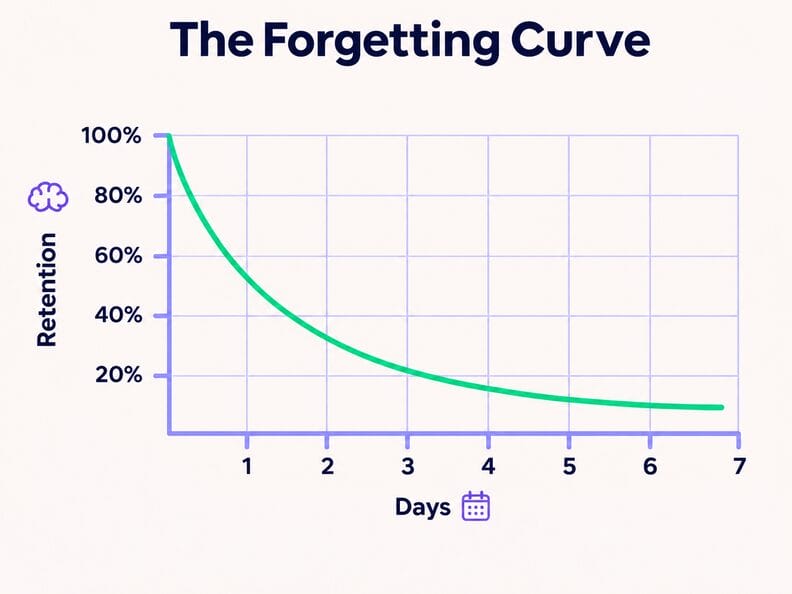
The forgetting curve is a graph of how much people remember at different points after learning. Without review or practice, recall usually drops quickly at first and more slowly later.
For example, a new hire might complete a procedure successfully at the end of a training program but struggle with the same task a week later. The forgetting curve helps explain why this happens and how much information people tend to forget over time.
What the Ebbinghaus forgetting curve shows
German psychologist Hermann Ebbinghaus discovered the forgetting curve in 1885. He published the results of memory experiments he had run on himself. He memorized lists of nonsense syllables, waited anywhere from about 20 minutes to a month, and timed how long it took to learn them again.
The horizontal axis shows how long he waited. The vertical axis shows how much time he saved on relearning, as a percentage of the time he spent learning the lists in the first place. Retention dropped sharply at first and more slowly later. After one day, relearning still took about a third less time.
Why memory consolidation matters
Students often need a concept from one lesson to make sense of the next. An employee may go several shifts before using a new procedure on their own. Memory consolidation helps newly learned information become more stable in the meantime.
On a first solo shift, a front desk hire might call a supervisor halfway through a reservation change while the guest waits. A request for customer records can sit in a shared inbox if someone forgets who handles it. A rep who mixes up two plans might promise a feature from the pricier one, while a manager in a rush might fall back on “be more careful” after practicing more specific feedback. If employees return to the old order-entry steps, the corrections eat into the time the training was meant to save.
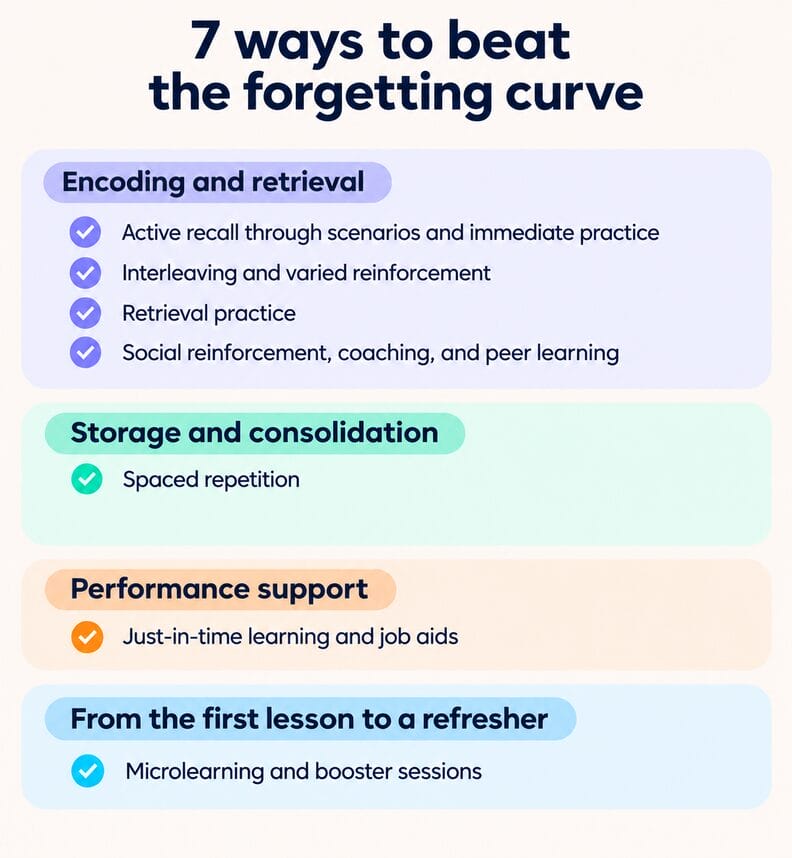
How to beat the forgetting curve: 7 efficient strategies
Think about a procedure someone learns during training and first uses on their own a few shifts later. Ebbinghaus’s curve gives us a way to think about what can happen to that knowledge in the meantime.
Encoding and retrieval
1. Active recall through scenarios and immediate practice
Active recall strengthens retrieval pathways in the brain. Give learners a customer return to handle as soon as the demo ends. The customer has lost the receipt, so employees have to remember what proof of purchase they can accept and decide how to proceed. Let them check the policy after they’ve made their decision. Active recall techniques include the blank page test and self-quizzing.
2. Interleaving and varied reinforcement
Interleaved practice involves mixing different topics in a single study session to enhance retention. Mix area and perimeter problems in a single practice set. One problem can ask how much fencing a garden needs, and the next can ask how much turf would cover it. Students have to work out which measurement applies. Contextual learning improves retention by 3–4 times for relevant information.
3. Retrieval practice
A few days after training on repair tickets, ask employees to name the field where they record a completed repair. Give them time to answer from memory before showing them the field on screen. In an online course, you can set this up as a short-answer question with feedback in your authoring tool.
4. Social reinforcement, coaching, and peer learning
Peer learning can improve retention by up to 50%. During a shift huddle, pair employees and give them a workplace scenario to discuss, such as a delivery with missing items. One employee recalls the steps from memory while the other checks them against the guide. At the next check-in, a supervisor can identify any missed steps, provide feedback, and give employees another opportunity to practice.
Storage and consolidation
5. Spaced repetition
A few days after training on stock counts, ask employees how they’d record a mismatch. Bring the same step back in a short case before the next inventory. Adjust the gaps based on when the team will need the procedure and which details they’re still mixing up.
Performance support
6. Just-in-time learning and job aids
A front desk employee who rarely cancels a group booking might need the steps while the customer is on the phone. Link a short checklist from the booking screen so they can follow it as they work. A screen recording in the same place can walk them through an unfamiliar step.
From the first lesson to a refresher
7. Microlearning and booster sessions
A microlearning lesson can show staff what to tell a coworker when transferring a customer call. For a booster a few shifts later, play a clip from a different call and let them try the handoff before showing a sample.
A learning platform can schedule these lessons and follow-up activities. For example, iSpring LMS lets you set a due date before staff start taking calls on their own and schedule a reminder. If several learners leave out the same detail, bring it back in the next practice case.

Example of a forgetting-curve reinforcement plan
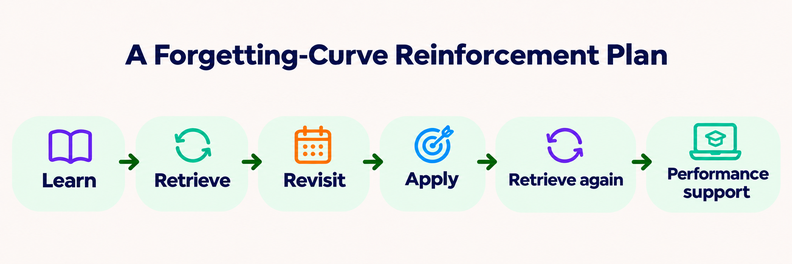
For a team learning to hand off customer calls, plan the first review around when staff will start taking calls on their own. Use what they remember at that review to decide when they need more practice.
| Step | When | What learners do |
| Step | When | What learners do |
| Learn | During the lesson | Listen to a handoff that covers why the customer called and what’s already been tried. |
| Retrieve | Right after the lesson | Say in their own words what they’d pass on. |
| Revisit | Before taking calls on their own | Spot a missing detail in a sample handoff, then check it against the guide. |
| Apply | On a live call | Transfer the call and get feedback from the coworker who takes it. |
| Retrieve again | After some practice on shift | Talk through a handoff from memory for a different type of call. |
| Performance support | As needed during a call | Open the handoff checklist from the call screen. |
Check what employees can recall after a gap, then look at which details coworkers still have to ask for during live handoffs.
How to check what learners remember and can do
A call can reach the right team and still leave the next person asking what’s already been tried. A call review catches that gap. Because self-quizzing reinforces understanding and retention, a delayed quiz can show whether the employee remembers to pass that detail on when asked.
- Delayed knowledge checks. Ask about the same key points at the end of training and again after a gap. Use a fresh prompt the second time and compare the scores.
- Scenario performance. Try a practice call with an unresolved issue. Use your handoff criteria to check whether the learner tells the next person what still needs to be done.
- Time to competency. Record how many shifts a new hire needs before they can handle a complete handoff independently.
- Error rates. For similar calls, compare how many transfers go to the wrong team per 100 handoffs before and after training.
- Compliance behavior. Pull a sample of cases that call for a transfer note. Count how many include the reason for the transfer.
- On-the-job performance. Review live handoffs and note how often the next person has to ask for more information before they can pick up the case.
Each review of material resets the forgetting curve.
Common training mistakes that let forgetting go unchecked
When the opening checklist changes, a rushed walkthrough can leave employees unsure where the new step fits. Connecting it to something they already do helps them understand and learn it (encoding). Keeping that information in memory is called storage, while consolidation helps make the memory stronger over time. But without regular practice, employees may struggle to recall the step (retrieval) when they need it.
Planning around “90% forgotten.”
Using the 90% figure as a rule can put every course on the same review schedule. A daily task gets practiced on shift, while an exception may come up only twice a year. Plan reviews around when employees will need the material and what they still struggle to recall.
Treating microlearning as a one-off
Short videos help employees learn new tasks, but watching them once is not enough. Have employees use what they’ve learned: bring back decisions in future practice activities to reinforce their knowledge.
Showing the answer too soon.
Putting the opening checklist on screen at the start of a review gives learners the steps while they answer. Rereading can feel productive because the steps look familiar. Ask learners to say what comes next in their own words, then show the checklist so they can check their answer.
Stopping after one refresher
Good scores on an early refresher can make it tempting to stop while the lesson is still fresh. By the time employees need the procedure on shift, some details may be harder to recall. Run another check closer to when they’ll use the skill and revisit the steps they miss.
Stopping at the completion report
A completion report doesn’t tell you how much learners remember or how well they apply it. Plan follow-ups, check retention with a quiz after some time has passed, and track on-the-job results to see whether employees are applying what they’ve learned.
Final word
A short refresher can fit between two lessons or before a first solo shift. Build it around one problem learners will have to solve or one decision they’ll have to make. A diagram from class or a screenshot from the job can give them enough context for a single question.
Ask learners to answer from memory, then use their mistakes to identify what needs more practice. With a tool like iSpring Suite, you can easily create interactive quizzes and short refresher courses to reinforce learning over time. Want to see how it works? Request a live iSpring Suite demo to explore how you can build these activities into your training.
FAQ
What is the Ebbinghaus forgetting curve?
The Ebbinghaus forgetting curve shows that people forget new information quickly at first, then more slowly over time. Ebbinghaus studied this by measuring how much time people saved when relearning information after different periods.
What factors influence the forgetting curve?
The forgetting curve is influenced by several factors:
- Material Difficulty: Complex information is often forgotten faster, especially when it isn’t fully understood.
- Meaningfulness: Relevant and practical information is easier to remember, thus staying with learners longer.
- Prior knowledge: Connecting new information to existing knowledge helps improve retention.
- Regular review: Reviewing material at spaced intervals strengthens memory and helps slow down forgetting.
How do you mitigate the forgetting curve?
Revisit the material after a gap and give learners a fresh example to work through from memory. In class, try a new problem that uses the same concept. At work, give new hires a different maintenance request and ask what they’d record before they open the guide.
How does spaced learning help retain information?
Spaced repetition is based on the psychological spacing effect. A stock-count rule taught on Monday might come up again later that week and before the next inventory. Spacing those reviews helps staff remember the rule when they need it.
What is the difference between spaced repetition and active recall?
You can use active recall right after a lesson by asking learners to answer from memory. Repeat that practice a few shifts later, and you’ve added spacing.
Create online courses and assessments in record time.





14 Proven Training Methods for Boosting Staff Performance

How to Create Training Materials That Drive Employee Success
