Cognitive Learning Theory Explained
 13 minutes





Learning often looks tidy on paper: a course, a deadline, a completion rate. But in reality, it’s rarely that simple. People absorb information in different ways. Some need context. Others need repetition. Many need some time to pause and reflect.
Cognitive learning theory is based on this understanding. It focuses on how people take in information, make sense of it, and use it later on.
That matters in the classroom, where understanding builds layer by layer — and just as much in the workplace, where learning has to show up in decisions and measurable results.
In this article, we’ll explore what cognitive learning theory is, why it matters, and how it translates into daily practice.
TL;DR
The article explains cognitive learning theory as a framework that views learning as an internal mental process focused on how people take in, understand, and use information rather than simply responding to stimuli. It outlines core ideas about attention, memory, prior knowledge, and reflection, and discusses how these principles apply in classrooms and workplaces to improve retention, relevance, and real-world application. The piece also highlights benefits such as deeper understanding and engagement, alongside challenges like cognitive overload and the need for thoughtful instructional design.
Cognitive Learning Theory Definition
So, what is cognitive learning theory? At its simplest, it views learning as an internal process. Not just something people do, but something they understand.
This perspective developed as a response to behaviorism. That measures learning mainly through actions and outcomes. However, cognitive learning theory theorists pushed back. They argued that thinking, memory, and problem-solving deserved attention too.
It’s not like constructivist approaches that focus on shared discovery, but a theory that emphasizes how individuals organize information in their minds. The aim is not compliance or repetition. It’s comprehension. When learners understand, behavior tends to follow.
Key Principles of Cognitive Learning Theory
Cognitive learning theory is based on a few ideas. They feel natural once you see them in real life.
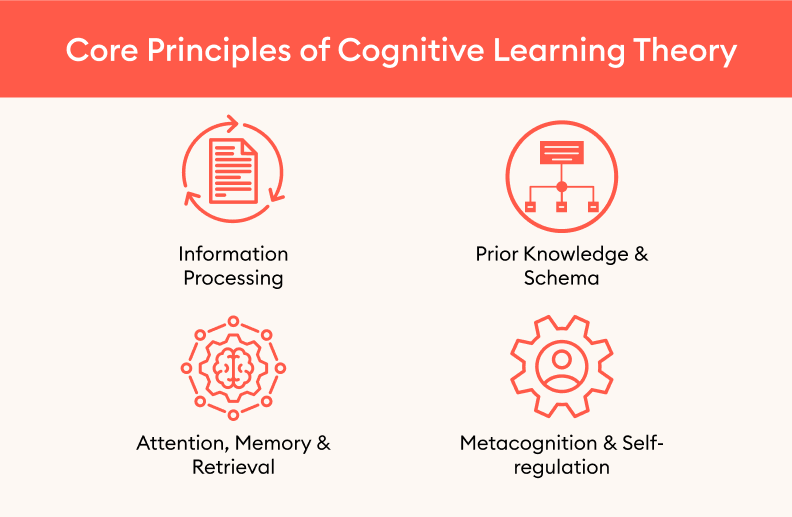
- Information Processing: The brain has limits. Attention is selective, and working memory is fragile. Understanding can break down when learning moves too fast or delivers too much at once.
- Prior Knowledge and Schema: New ideas don’t start from zero. People understand information that they already know. These past experiences shape meaning. Learning works better when instruction acknowledges them instead of ignoring them.
- Attention, Memory, and Retrieval: Retention improves when learners engage actively. Retrieval matters. Struggling a bit to recall information boosts memory far more than passive review.
- Metacognition and Self-regulation: Strong learners notice when something doesn’t make sense. They pause. They adjust. Training that encourages reflection helps learners build this awareness.
In cognitive learning theory in education and workplace settings, these principles guide how learning is structured, not just what content is delivered.
How Cognitive Learning Works in Practice
Cognitive learning theory shows up wherever learning is designed with care.
In education
In classrooms, structure matters greatly. Lessons build on each other instead of competing for attention. Teachers review recently learned content before introducing new material. Concepts are broken down into manageable pieces. Visuals and examples reduce mental strain, and reflection gives students space to connect the ideas. This is how cognitive learning theory works in the classroom. Not flashy, just thoughtful.

In the workplace
The workplace brings different pressures. Time is short, and distractions are continuous. Learners are expected to apply knowledge quickly. Cognitive learning theory helps by emphasizing sequencing and relevance.
Training becomes easier to absorb when it is organized into stages and reinforced through practice. Learning paths that blend short modules with real tasks support transfer without overload. Many teams rely on an LMS to keep this structure clear and flexible as roles and needs change.

Too much to read? Get a summary from AI
Observational and social learning
People learn by watching others work. Seeing a task performed well provides context that instructions alone cannot. Shadowing, demonstrations, and shared examples turn abstract guidance into something usable. Social learning works best when it encourages reflection instead of noise.
The goal stays the same across settings. Learning should help people think better, not just finish faster.

Benefits of Applying Cognitive Learning
The benefits of cognitive learning theory become clear when learning starts to last. At its core, it is about how people think, not just what they do. Outcomes often shift in meaningful ways when training aligns with this concept.
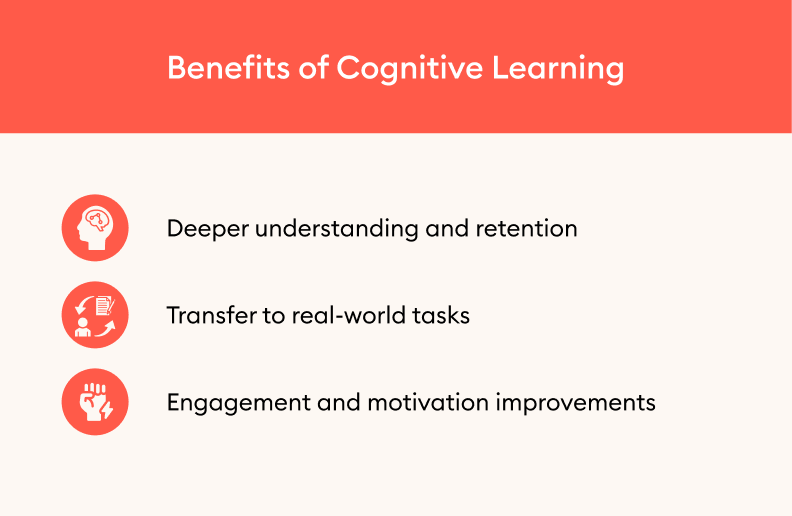
Deeper understanding and retention
Learning improves when information is organized based on meaning instead of volume. Cognitive approaches reduce overload and help learners connect ideas. This makes recall easier later, when information is actually needed. Instead of memorizing steps, learners understand why those steps matter. Logical structure and thoughtful sequencing play a big role here — especially when learning needs to scale across teams.
Transfer to real-world tasks
One of the strongest benefits is application. Cognitive learning emphasizes practice and reflection. Learners are asked to use information, not just repeat it. This supports transfer. Skills move from training environments into daily work.
In many organizations, an LMS supports this process by linking formal courses with follow-up exercises or on-the-job development. It can guide learners and ensure that practice continues after the initial training. When learners get the chance to apply knowledge, skills become meaningful. Confidence grows, and learning starts to feel useful.
Engagement and improvement in motivation
People are attentive when learning feels relevant. Cognitive learning encourages curiosity by providing space for exploration. Learners like to stay engaged when content respects their experience. Allowing choice in pace or focus can reinforce this sense of ownership, without adding unnecessary complexity.
Taken together, these benefits form a practical cognitive learning theory overview. Learning accelerates. Retention improves, and effort feels worthwhile.
Challenges
Cognitive learning theory offers strong guidance. However, applying it well requires care.
Cognitive overload
One of the most common problems is getting too much information at one time. Courses try to cover everything. Slides fill up. Modules stretch longer. And finally, the learners’ attention drops. Learning slows down or stops when working memory is overwhelmed. Managing pace and structure becomes very difficult — especially when programs grow larger or more complex over time.
Pro tip: Break learning down into smaller, focused chunks — short modules with clear goals.
Ineffective rote learning
Rote learning still appears in many programs. Finish the module. Pass the quiz. Move on. This approach may seem efficient, but it rarely leads to understanding. Learners forget what they crammed. Skills fail to transfer. Cognitive learning theory challenges this pattern by prioritizing practice over repetition. Designing for practice and reflection takes more effort. But the payoff is enhanced retention.
Pro tip: Include activities that encourage critical thinking and application: scenario-based exercises, guided reflections, or real-world problem solving.
Motivational and individual differences
Learners never start at the same level. Backgrounds and knowledge differ. Attention fluctuates. Some learners want structure. Others need flexibility. When programs ignore these differences, frustration grows and engagement drops. This challenge often appears in cognitive learning theory in education and workplace learning. Tools like an LMS can help support variation. But only when learning design comes first.
Pro tip: Build role-based programs that adapt to individual goals and progress.
These challenges don’t weaken cognitive learning theory; they reinforce the need for thoughtful and learner-centered design.
Instructional Strategies Based on Cognitive Theory
Connect new info to existing schemas
Background and experiences vary a lot for each learner. They apply their existing knowledge to the learning space. And the outcome? New information makes sense only when it connects to what is already familiar. When instruction builds on prior understanding, learners can organize ideas more easily. They are not guessing to see where the information might fit. Cognitive learning highlights this process because memory relies on meaning. Learning feels less forced, and understanding feels natural.
Spacing, retrieval practice, and chunking
Attention shifts quickly. Long lessons exhaust learners’ focus. And too much information ultimately leads to overload. Spacing helps by spreading learning out over time. Short sessions feel manageable. Retrieval practice strengthens memory by asking learners to recall information. This effort improves retention. Chunking divides complex topics into smaller parts. That helps to process one idea at a time. All these strategies reduce strain and support long-term learning.
Design realistic scenarios and practice tasks
Learning sticks when it feels real. Abstract explanations fade quickly. Scenarios place learners in familiar situations. Practice tasks encourage thinking and decision-making. Learners test ideas. They make mistakes. Reflection follows. This process builds strong mental models that reflect actual work. Cognitive theory values these practices because understanding grows through use — not observation alone.
Support personalized adaptive learning
Learners progress at different speeds. Some need repetition, while others require challenge. Personalized learning respects these differences. The goal remains clear; just the route changes. An LMS can support this flexibility when learning design leads the way.
These strategies do not weaken cognitive learning. They strengthen it. They respect attention, memory, and motivation. Most importantly, they maintain learning as being human, thoughtful, and learner-centered.
Tools and Technologies That Support Cognitive Learning
Technology can support learning when it follows the way people think. It should reduce effort —not increase it. Cognitive learning theory focuses on understanding and memory. The right tool helps learners process information clearly and apply it with confidence.
LMS features that support cognitive learning
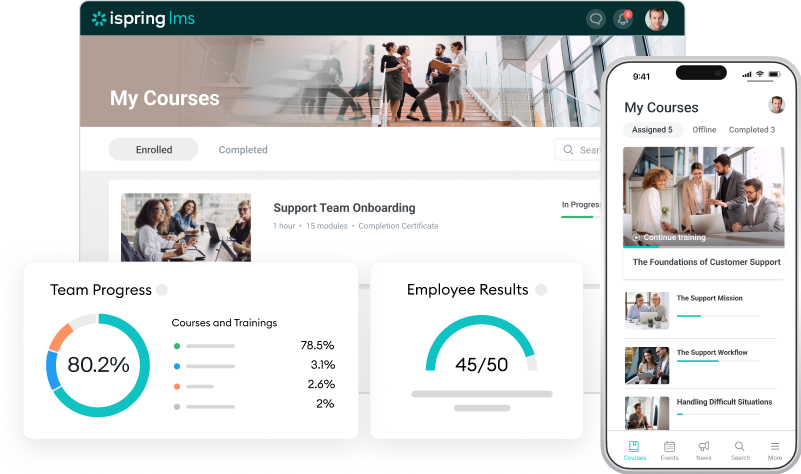
A learning management system can support cognitive learning when used purposefully.
Microlearning is one example. Brief lessons respect shorter attention spans. Learners can focus on one idea at a time. This reduces overload and improves recall. Microlearning fits into busy workdays, too.
Analytics help L&D teams understand what’s working and what’s not. Completion rates show patterns. Time spent highlights effort. And drop-off points reveal confusion. These signals guide improvement. They support better design decisions. When data informs changes, learning becomes more responsive and effective.
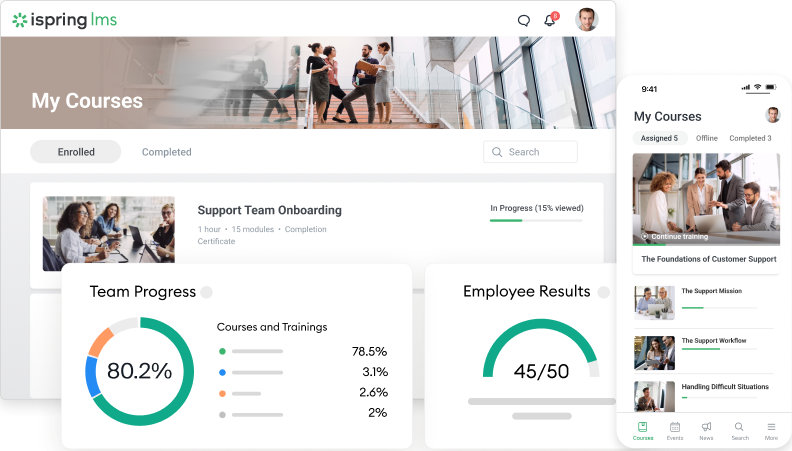
Content recommendations also play a significant role in this. When learners receive relevant suggestions, learning feels timely. Not random. Recommendations based on role, progress, or interest help learners stay focused. This supports motivation without adding pressure. The experience feels thoughtful rather than automated.
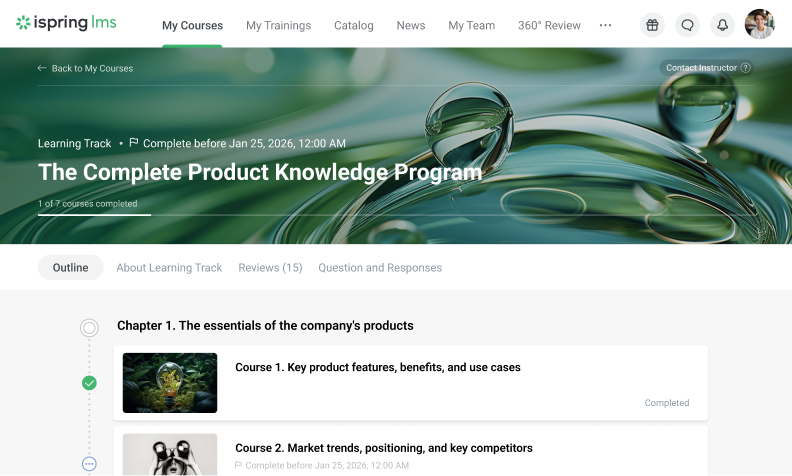
Learning tracks make this possible by turning goals into structured learning paths. iSpring LMS brings together courses, assessments, and resources into role-based programs that reflect how people actually grow into a position — not just how content is stored.
Interactive content and multimedia
Interaction strengthens the learning process. Passive reading often fades quickly, whereas interactive content encourages thinking and choice. Quizzes, reflections, and simple decision tasks support retrieval and practice. These moments help learners check understanding and correct errors early.
This is what an interactive knowledge check can look like:
Multimedia supports learning when used carefully. Visuals clarify complex ideas. Audio supports different learning preferences. And short videos explain processes better than long texts. The goal is clarity. Not decoration. Too much media distracts, while a simple design supports focus.
These tools do not replace good instruction; they support it. Cognitive learning improves when technology reduces friction and supports understanding. When tools follow human thinking, learning feels useful and lasting.
Case Studies
Real-life examples show how cognitive learning works in practice. They make the theory easier to understand. They also show how design choices can improve learning in both corporate and educational settings.
Mutual Materials improves training with iSpring
Mutual Materials is a manufacturing and distribution company in the U.S. with about 500 employees across 30 locations. They had difficulty getting staff to complete the training program. Their old tools were hard to use, and engagement was low.
The company chose iSpring Suite to make better eLearning courses. They liked that it could use PowerPoint to build content easily. They also appreciated the visuals, collaboration features, and review process.
Courses are short, clear, and easier for learners to finish. For employees without computers, they set up “knowledge stations” to allow everyone to access training.
After using iSpring, course creation became faster. They made nearly 100 strong training modules. The course completion rate boosted from about 60% to 90% — increasing engagement by half. Training is now more consistent and helps workers learn skills better.
Stellenbosch University uses iSpring with 5,000 medical students
Stellenbosch University in South Africa has nearly 5,000 medical students and over 1,600 staff members. They needed a way to make learning content available online for all. Many resources were not easy to share or access prior to using iSpring products.
They chose iSpring Suite because it lets instructors make interactive and engaging learning packages quickly and easily. These packages also work offline. The tools helped teachers convert traditional lectures into self-guided content during the COVID-19 pandemic.
The teachers found iSpring easy to use, and students received more interactive learning. Teachers could include role-plays and provide instant feedback. This helped the students learn practical skills for the real world.
Conclusion
Cognitive learning theory reminds us that people learn best when instruction respects how the mind works. Learning should feel clear — relevant and manageable. Personalized learning, a sound structure, and a thoughtful use of technology all support this goal. An LMS works best when learning design leads and tools follow.
The key takeaway is simple. Good learning is human-centered. Technology supports it and doesn’t replace it. If you want to apply these ideas in your own program, explore our practical guides, courses, or consultation options. Start small and design with intention. Build learning that truly lasts.
FAQs
What is cognitive learning theory?
Cognitive learning theory examines how people think and make sense of information. It focuses on attention, memory, and understanding. Learning is not just about repeating facts. It is about meaning. When learners see how ideas connect, information becomes easier to remember. It also becomes easier to use. That’s why learning based on understanding lasts longer and feels more valuable in real life.
How does cognitive learning theory differ from behaviorism?
Behaviorism focuses on visible actions and responses. It relies on repetition, rewards, and reinforcement. Cognitive learning theory looks inside the mind. It focuses on understanding not just behavior. Instead of asking, “Did the learner respond correctly?” it asks, “Does the learner understand why?”
How can I apply it in training design?
Start by organizing content clearly. Connect new ideas to existing knowledge. Use brief lessons. Add practice and reflection. Reduce overload. Support different learning needs. When training respects how people think, learning becomes cleaner, more engaging, and more effective.
Why is attention important in cognitive learning?
Attention is the starting point of learning. Without focus, information does not enter the learning process. Clear goals, relevant content, and simple design help learners stay attentive.
Create online courses and assessments in record time.





Learning Experience Design: How To Make Courses Stick
