NAOS: “With iSpring, We’ve Standardized Training Across International Markets”
 7 minutes


NAOS is an international skincare company behind the BIODERMA, Institut Esthederm, and Etat Pur brands. It delivers training across markets, teams, and partner networks worldwide.
Its journey with iSpring began back in 2020, when the company needed to move training online quickly, and has evolved significantly since then. In this case study, Véronique Bonard, Global Training Director at NAOS, shares how the company now uses iSpring Suite AI to make digital training easier to create, manage, and scale internationally.
Background

Global Training Director at NAOS
At NAOS, we operate across 47 subsidiaries and have around 3,500 employees worldwide, with teams spread across headquarters, local markets, and partner networks.
As Global Training Director, I define and lead our global training strategy for our brands and Products. I make sure it aligns with the company’s business, scientific, regulatory, and learning priorities. I also work with our teams on the design, rollout, and evaluation of training programs for international markets.
Our Campus team includes 12 people, mainly instructional designers. We also work with an international network of around 80 trainers.
We train a wide range of audiences, including internal teams, sales teams, local trainers, international subsidiaries, and partners. Depending on the program, we also train external audiences.
Our training approach is primarily blended, combining digital modules, quizzes, certifications, and self-paced activities with trainer-led sessions.
The Challenge: Scale Training Across a Distributed Organization
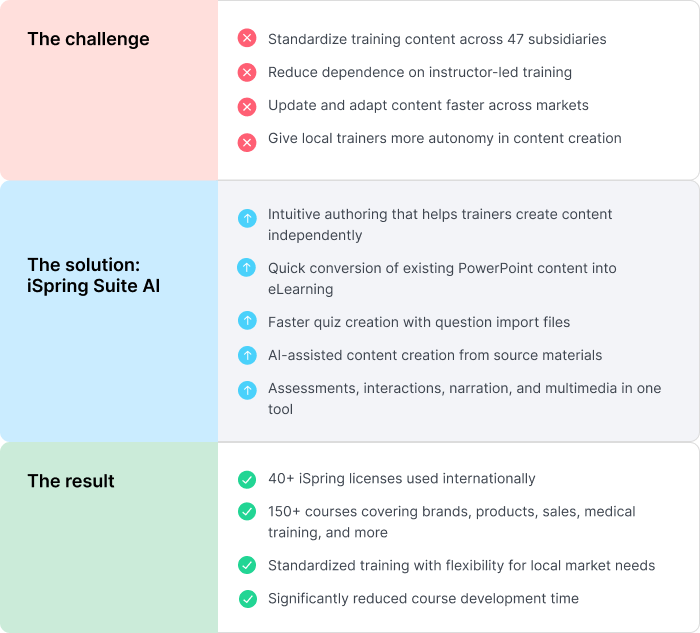
Before iSpring, NAOS’s training model was still largely built around in-person sessions. The way training was organized also differed considerably between markets.
Before iSpring, training relied more on face-to-face formats, PowerPoint materials, trainer-led sessions, and local setups that sometimes varied significantly from country to country.
Véronique Bonard
As the company expanded digital learning internationally, this decentralized model became increasingly difficult to scale. Course production and maintenance also required substantial input from local teams.
Content was often created and adapted manually, with a strong dependence on trainers and local teams for rollout, updates, and learner follow-up.
Véronique Bonard
NAOS needed a more sustainable way to serve distributed audiences while keeping key messages aligned across markets. Speed mattered too: training content had to keep pace with changing business and country needs.
Our main challenges were harmonizing messages internationally, updating content quickly, training audiences spread across many countries, and accurately tracking training activity.
Véronique Bonard
At the same time, the goal wasn’t simply to replace classroom training with online courses. NAOS wanted to make learning easier to access and give learners more independence while preserving the value of trainer-led sessions.
We wanted to make content more accessible, allow learners to train at their own pace, and give trainers the means to produce high-quality digital modules themselves.
Véronique Bonard
The Solution: iSpring Suite AI
NAOS first adopted iSpring during the COVID-19 lockdown, when the training team needed a reliable way to move learning online quickly. As we shared in our first NAOS case study, Véronique Bonard helped introduce iSpring to the company back in 2020.
We chose iSpring Suite and iSpring Learn for their simplicity, quick implementation, and the ease with which our teams could turn existing PowerPoint materials into eLearning modules. Responsive customer service and Tania’s support were also decisive: everything was set up within a few days, which was essential in our emergency context.
Véronique Bonard
Since then, NAOS’s digital learning ecosystem has evolved. The company has streamlined its authoring tools based on cost, functionality, usage, and value. After comparing different solutions, NAOS retained iSpring Suite AI as the main authoring tool for its Campus and local training team.
Intuitive PowerPoint-based authoring
NAOS values iSpring Suite AI for its low learning curve. The interface is straightforward enough for trainers to become productive quickly, while accessible tutorials help them build confidence without extensive technical training. This matters for a global training function that involves a broad network of trainers, not just a small central authoring team.
Easy access to tutorials was also important, as it helped teams get up to speed quickly and work independently.
Véronique Bonard
At NAOS, most courses start with validated PowerPoint materials containing scientific, marketing, regulatory, and learning content. The team adapts them to the learning objectives and audience, then turns them into eLearning with iSpring.
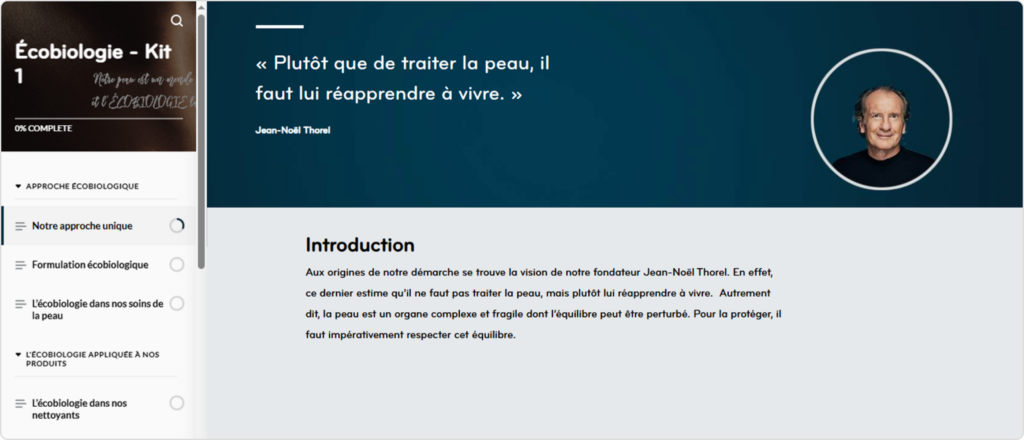
The most important features were the ability to create eLearning modules quickly from PowerPoint and add quizzes, interactions, narration, and multimedia while maintaining a clear learning structure.
Véronique Bonard
This workflow is especially efficient when the source materials are already structured, helping NAOS shorten course development time.
AI-assisted authoring grounded in source materials
NAOS is also expanding its use of iSpring Suite AI beyond traditional PowerPoint-based authoring. With the newer AI capabilities, the team can upload internal source files and use them as the basis for generating and structuring course content.
This fits naturally into NAOS’s existing development process. Instead of starting from scratch, the team can upload its validated internal materials and use them as the basis for AI-assisted content creation and structuring.
These developments save time, make it easier to structure content, and speed up certain stages of design, particularly through the ability to import a source file to create content, which helps limit AI hallucinations.
Véronique Bonard
For knowledge checks and assessments, NAOS uses question import files:
The new AI features also help shorten certain stages of course creation, especially quiz development, thanks to question import files that simplify the generation, organization, and integration of assessments into learning paths.
Véronique Bonard
Véronique also noted that the cloud-based part of iSpring Suite AI, including page-based authoring, is giving the team more ways to create and organize eLearning content.

The Results Achieved with iSpring
Six years after NAOS first introduced iSpring, Suite AI has become the primary authoring tool for the Campus NAOS training team. The company now has more than 40 iSpring licenses in use internationally.
The impact is most visible in the way training content is produced and scaled across markets.
iSpring has given our trainers greater autonomy in content creation while reducing production time. It has also helped us standardize learning paths, integrate quizzes and assessment activities more easily, and make content accessible to audiences across different countries.
Véronique Bonard
Today, NAOS’s digital learning portfolio includes more than 150 courses covering brands, products, ecobiology, sales methods, medical detailing, job-specific practices, and train-the-trainer programs. The portfolio continues to evolve as content is updated and adapted for new launches, country priorities, and changing training needs.

Course development has also become faster. A full digital learning path takes around 40 hours to develop on average, depending on the complexity of the content. Véronique notes that iSpring can significantly shorten production time when the source materials are already structured, while newer AI capabilities help accelerate specific stages even further.
This simplicity of content production and delivery has been an important lever in accelerating the digitalization of our training.
Véronique Bonard
The company is now conducting its own impact and ROI study to understand how blended learning contributes to knowledge acquisition, engagement, transfer to the job, and, where possible, business performance.
The team also collects learner feedback for each learning path and evaluates digital content separately from live training. This gives NAOS a clearer view of what works in its asynchronous learning and helps the team continue refining the experience as its digital training strategy evolves.
Create online courses and assessments in record time.