Why Microlearning Works — And How to Design Learning That Actually Sticks
 6 minutes

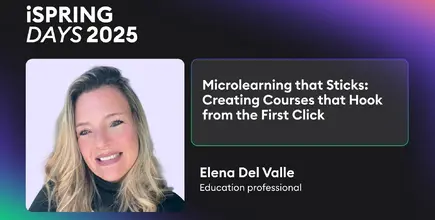
This article is adapted from a session presented at iSpring Days APAC 2025.

At iSpring Days APAC 2025, instructional designer Elena Del Valle explored what makes microlearning truly effective — not just shorter, but more engaging, memorable, and emotionally meaningful.
The session focused on a challenge many learning teams face today: Modern learners are overwhelmed, distracted, and short on time. Traditional long-form training often struggles to hold attention, especially in fast-moving work environments.
Elena shared practical strategies for designing microlearning experiences that connect emotionally, improve retention, and fit naturally into everyday life.
In this article:
- Why microlearning works so well for modern learners
- How to design learning experiences that capture attention quickly
- The psychology behind memorable learning
- Why emotional connection matters in eLearning
- Examples of interactive microlearning techniques
- Common mistakes to avoid in microlearning design
Best for:
Instructional designers, L&D teams, HR professionals, onboarding specialists, trainers, and anyone creating modern workplace learning experiences.
Key Takeaways
- Microlearning works because it fits naturally into real life
- Short content is only effective when it stays focused and intentional
- Emotional connection improves retention and engagement
- Storytelling and interaction matter more than content length
- Learners remember experiences, not just information
- Mobile-first learning is becoming essential for modern audiences
Join us for iSpring Days ANZ & APAC on June 9-10
Why Microlearning Became So Important
One of the most relatable moments in Elena Del Valle’s session came early on, when she described microlearning not as a trend, but as something people already use every day.
You forget how to check whether a steak is medium rare.
You search for a 60-second tutorial.
You solve the problem immediately and move on with your life.
That, Elena explained, is microlearning in its most natural form.
It appears:
- just in time
- just enough
- just when you need it
And that’s exactly why the format works so well.
Modern Learners Don’t Need More Information
They need less friction.
Traditional workplace training often assumes learners can dedicate long uninterrupted blocks of attention to learning.
But real life rarely works that way.
People are balancing:
- meetings
- messages
- deadlines
- family responsibilities
- constant notifications
- operational pressure
As Elena put it during the session:
“People are busy between meetings, emails, family, errands, and everyday chaos.”
That changes how learning needs to be designed.
Modern learning experiences need to:
- fit into small moments
- reduce mental effort
- feel immediately relevant
- work across devices
- respect learners’ time
Microlearning succeeds because it adapts to human behavior instead of fighting against it.
Why Shorter Learning Often Works Better
One of the biggest misconceptions about microlearning is that it simply means making content shorter.
But Elena emphasized that effective microlearning is not about shrinking information.
It’s about focus.
Each microlearning experience should concentrate on:
- one concept
- one skill
- one decision
- one learning objective
When too much information is packed into a small format, learners still become overwhelmed.
But when content stays focused, the brain processes it more naturally.
As Elena explained:
“Traditional learning dumps everything at once and hopes some of it sticks. Microlearning is smarter.”
That distinction matters.
Why Emotional Design Matters in Learning
One of the strongest ideas throughout the session was that people remember feelings more than slides.
Elena repeatedly returned to the idea that memorable learning experiences create emotional connection:
- curiosity
- empathy
- tension
- humor
- recognition
- surprise
That emotional layer helps information stay in long-term memory.
Instead of simply presenting procedures or facts, she encouraged learning designers to build experiences learners can relate to emotionally.
For example:
- frustrated customers
- realistic workplace situations
- relatable mistakes
- meaningful stories
- moments of tension and resolution
These experiences activate attention differently than static information alone.
The Power of Storytelling in Microlearning
One particularly memorable example from the session came from a real-world blackout that recently affected parts of Spain.
Elena used the event as the foundation for a short learning story about human communication and reconnection.
Instead of teaching communication skills directly, the experience focused on something people emotionally recognized:
- silence
- disconnection
- candles
- conversation
- rediscovering human connection
The learning worked not because it explained communication theory.
It worked because it created emotional resonance.
As Elena described it:
“That’s when microlearning stops being content and becomes connection.”
That may be one of the most important lessons for modern instructional design.
Why Interaction Makes Learning Stick
Another major focus of the session was active participation.
Elena emphasized that learners remember much more when they:
- choose
- respond
- explore
- decide
- fail safely
- try again
Instead of passively consuming information, learners become participants inside the experience.
The session included several examples:
- customer service simulations
- hotspot activities
- branching scenarios
- interactive decision-making
- visual exploration exercises
In one example, learners had to respond to an angry customer inside a simulated interaction.
The important part was not simply choosing the correct answer.
It was understanding why certain responses build trust while others damage it.
That type of emotional and contextual learning tends to stay with people much longer than static explanations.
Why Mobile-First Learning Is No Longer Optional
Elena also emphasized how deeply learning habits have changed.
Modern learners increasingly consume content:
- on mobile devices
- during short breaks
- between tasks
- asynchronously
- outside traditional classrooms
That changes design priorities significantly.
Microlearning works well because it naturally adapts to these environments:
- short attention windows
- fragmented schedules
- mobile usage patterns
- on-demand learning behavior
And importantly, learners no longer expect training to feel separate from the digital experiences they use every day.
The Most Common Microlearning Mistakes
Toward the end of the session, Elena shared several common pitfalls that weaken microlearning effectiveness.
One of the biggest mistakes is trying to cram too much information into a single module.
Another is creating passive experiences with little interaction.
She also warned against overusing generic stock visuals that disconnect learners emotionally from the content.
According to Elena, effective microlearning should feel:
- specific
- human
- relevant
- emotionally recognizable
Not generic.
Why “Sticky” Learning Matters More Than Ever
One of the broader ideas running throughout the session was that modern learners are not struggling because they lack information.
They are struggling because attention has become fragmented.
That means learning experiences now compete with:
- social media
- messaging apps
- notifications
- multitasking
- constant digital stimulation
Simply presenting information is no longer enough.
Learning needs to:
- create connection
- trigger curiosity
- feel personally relevant
- invite participation
- respect cognitive limits
That’s why “sticky” learning matters.
Not because it is shorter.
Because it is designed around how people actually think and behave.
Final Thoughts
Elena Del Valle’s session was ultimately less about microlearning formats and more about human-centered learning design.
The strongest takeaway may be this:
People do not remember content simply because they saw it.
They remember experiences that made them:
- feel something
- decide something
- recognize themselves
- connect emotionally
- participate actively
Microlearning works best when it respects both human attention and human emotion.
And when done well, even a very small learning moment can create a surprisingly lasting impact.
Watch the Full Session
Microlearning that Sticks
Presented by Elena Del Valle at iSpring Days APAC 2025
Create online courses and assessments in record time.



9 eLearning Content Types to Include in Your Training Program

14 Proven Training Methods for Boosting Staff Performance
How to Scale Course Creation Without Building a Huge L&D Team
