How to Scale Course Creation Without Building a Huge L&D Team
 6 minutes

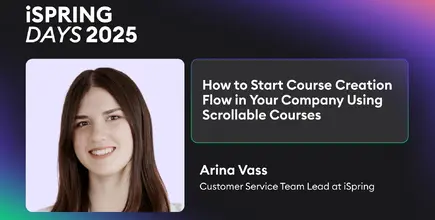
Editor’s note: This article is based on a session from iSpring Days APAC 2025 and has been adapted for readability and clarity.

At iSpring Days APAC, Arina Vass shared a practical framework for scaling online course production using scrollable courses, lightweight workflows, and AI-assisted content creation.
The session focuses on a challenge many growing companies face: Training demand increases fast — but course production often remains slow, expensive, and dependent on a small number of specialists.
In this session, Arina explains how organizations can simplify course creation workflows, involve internal experts in training development, and produce mobile-friendly learning content much faster.
In this article:
1. Why course creation becomes a bottleneck as companies grow
2. How scrollable courses simplify eLearning development
3. Ways to scale training without hiring a large instructional design team
4. Why operational workflows matter more than complex course production
5. How AI can speed up training development
6. What companies should prioritize when building internal training teams
Best for:
L&D teams, HR managers, onboarding specialists, instructional designers, customer education teams, and companies building training operations for the first time.
Key Takeaways
- Most workplace training does not require long, complex production cycles
- Scrollable courses can dramatically reduce course creation time
- Training bottlenecks are often operational, not technical
- Internal experts can contribute to course creation with the right process
- AI works best as a workflow accelerator, not a replacement for instructional design
- Mobile-friendly learning formats are becoming essential for distributed teams
Why Traditional eLearning Production Often Moves Too Slowly
Many organizations unintentionally create training workflows that are far heavier than they need to be.
A relatively simple training request suddenly requires:
- storyboarding
- design support
- multiple approvals
- technical publishing
- LMS testing
- several review rounds
Weeks pass before employees see the final training.
Meanwhile, the actual business need may simply be:
- communicating a process update
- reducing mistakes
- onboarding new employees faster
- sharing operational knowledge
- explaining a policy change
In these situations, speed and clarity matter more than highly produced interactive experiences.
That’s one reason why scrollable courses are becoming increasingly popular.
Why Scrollable Courses Work So Well for Workplace Learning
Scrollable courses behave more like modern web content than traditional slide-based eLearning.
Instead of clicking through slides, learners naturally scroll through content blocks that combine:
- text
- images
- callouts
- interactive elements
- quizzes
- embedded media
The format feels lighter and easier to consume, especially on mobile devices.
But the biggest advantage is operational.
According to Arina:
Experience has shown that scrollable courses are sufficient for 80% of tasks, especially because they are made much faster.
That speed changes what training teams can realistically support.
Instead of spending weeks developing every course, organizations can create and update learning content continuously. Engaging training manual strategies can pave the way for more effective learning environments. They encourage collaboration among team members and empower employees to take ownership of their development. By implementing these strategies, organizations can ensure that their training materials remain relevant and impactful.
And in fast-moving companies, keeping training current is often more important than making it visually complex.
The Real Goal of Workplace Training
One of the most valuable ideas from the session was that businesses are not creating training for the sake of training itself.
Training exists to solve operational problems.
Sometimes the problem is:
- inconsistent onboarding
- low employee confidence
- support ticket overload
- compliance risk
- poor adoption of new processes
- customer communication issues
That changes how companies should think about course development.
The goal is not necessarily:
How sophisticated can we make this course?
The more important question is:
Can we create and update training quickly enough to support the business?
That operational mindset is becoming increasingly important for learning teams.
Why Companies Should Rethink Who Creates Learning Content
Traditionally, course creation has been treated as a highly specialized function.
But modern authoring tools are lowering the technical barrier significantly.
During the session, Arina explained that organizations can increasingly involve HR specialists, onboarding managers, trainers, team leads, subject matter experts, and former educators in the course creation process.
This does not mean instructional design stops mattering.
It means organizations can spend less time on technical production work and more time focusing on:
- content clarity
- operational relevance
- learner understanding
- communication quality
Interestingly, Arina emphasized that soft skills are often more important than advanced technical skills when building a new training team.
Communication ability, openness to feedback, willingness to learn, and attention to detail may matter more than mastering complex authoring software from day one.
The Most Overlooked Problem in Course Production
One of the most practical parts of the session focused on feedback workflows.
Because even when course creation itself becomes faster, review processes can still slow everything down.
A course gets reviewed by:
- managers
- HR
- operations
- subject matter experts
- legal teams
- stakeholders
Everyone suggests edits. Timelines slip. Projects become chaotic.
Eventually, the training is either delayed or outdated before launch.
Arina recommended simplifying this process significantly:
- define who can approve changes
- limit review rounds
- establish deadlines early
- agree on feedback formats in advance
Simple operational changes like these can dramatically improve training velocity.
Especially in organizations where policies, procedures, or compliance requirements change frequently.
Where AI Actually Helps in Course Creation
AI was another major topic during the webinar.
But instead of presenting AI as a replacement for instructional designers, Arina demonstrated a more practical approach.
AI works best when it reduces repetitive production work.
During the session, she showed how AI can help:
- generate quiz questions
- organize course outlines
- translate content
- structure information
- speed up formatting
She also made an important distinction:
I do not recommend using it for writing the whole course… but it will help you with ideas for sure.
That’s probably the most realistic use case for AI in workplace learning right now.
Not fully automated course generation.
Workflow acceleration.
Why Mobile-Friendly Learning Is Becoming Essential
Another important point from the session was how employees actually consume training today.
More learning now happens:
- remotely
- asynchronously
- between operational tasks
- on mobile devices
- outside classroom environments
This is especially true for:
- distributed teams
- frontline workers
- healthcare organizations
- logistics operations
- field service teams
- customer support teams
Scrollable courses naturally fit these usage patterns because they behave more like responsive web content than traditional eLearning modules.
And importantly, they remove much of the complexity involved in creating mobile-friendly training experiences.
Course Creation Is Becoming an Operational Capability
One of the strongest takeaways from the session is that training development is increasingly becoming an operational agility challenge.
The organizations that move fastest are often not the ones producing the most sophisticated courses.
They are the ones that can:
- update training quickly
- involve internal experts efficiently
- distribute knowledge consistently
- reduce production bottlenecks
- keep learning aligned with business changes
That requires a different approach to course creation.
Less focus on making every course perfect.
More focus on building sustainable systems for continuous knowledge sharing.
Final Thoughts
The most interesting part of Arina Vass’s session was not just the product demo.
It was the broader shift in mindset behind it.
Modern workplace learning is moving toward:
- lighter production workflows
- faster content updates
- collaborative course creation
- AI-assisted development
- mobile-first learning
- scalable internal knowledge sharing
And for many organizations, scrollable courses may be one of the simplest ways to start making that transition.
Watch the Full Session
How to Start Course Creation Flow in Your Company Using Scrollable Courses
Presented by Arina Vass at iSpring Days APAC 2025
Create online courses and assessments in record time.