iSpring helps me design award-winning and praise-worthy courses
 6 minutes

When you talk to Rebecca J. Mills, you immediately sense both precision and creativity. After a decade in education, she now works on global learning programs, most recently at Group Lotus and the National Autistic Society.
Her projects span instructional design, media creation, and LMS strategy — all driven by a clear principle: learning must feel human.
Rebecca’s work earned her the iSpring Course Creation Contest Summer 2025 victory, recognized by both our judges and other contestants — Rebecca’s peers around the world.
We spoke with Rebecca about her key professional drivers, her motivation, and how her experience with iSpring during the contest has changed her opinion about quality learning tools.
“I’ve had to be a bit of a Swiss Army knife”

Rebecca J. Mills
“One of the biggest challenges has been wearing many hats, from video editing and graphic design to scripting and SCORM packaging. On top of that, juggling LMS management, comms drafting, managing SMEs and project timelines, while still designing and developing engaging digital learning, keeps things interesting!”
For Rebecca, efficiency isn’t about cutting corners — it’s about creating space for creativity.
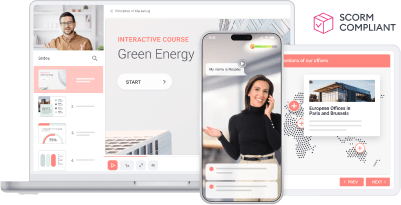
iSpring Suite AI allows her to build, test, and package entire courses directly from PowerPoint, without switching between authoring tools.
The simplicity of publishing straight to SCORM saves hours each week — hours that she invests in refining storylines, visuals, and learner journeys.
“Buy-in starts with understanding learners.”
“It’s important to understand the learner, not just the needs of the stakeholders and the SME. The buy-in has always been so much better when I’ve taken the time to explore the problem from the learner’s perspective.”
That philosophy mirrors her design method: short scenarios, clear language, and emotional anchors. iSpring’s interaction templates let her build those “relatable moments” quickly, without needing to code or outsource.
“When people see that the learning is relevant, practical, and designed with their reality in mind, they’re far more likely to engage with it.”
“Learning is a journey, not an event.”
“Establishing and maintaining momentum comes down to ensuring that learning isn’t a one-off event but an ongoing journey. I have developed a much more holistic view of learning over time, where I think about the before, during, and after.”
That cyclical mindset relies on agility.
With iSpring, Rebecca can update course sections, refresh quizzes, and re-upload the content to her LMS within minutes.
This way:
- Learners see timely updates.
- Stakeholders see progress reports.
- And Rebecca sees a smoother loop between insight and improvement.
All of it happens while the historical data remains intact.
Rebecca’s Insights
Over time, Rebecca has refined her approach to instructional design — moving from pure creation to strategy, empathy, and collaboration. We asked her to share a few principles that guide her work today:
Solve the right problem first.
“It’s not all about the technical whizzy stuff,” she says. “Understanding the real problem and solving it is more important.”
Rebecca begins every project with diagnostic thinking — identifying not just what content is missing, but which behavior or skill truly needs to change.
Designing isn’t the entire job.
Early in her career, Rebecca thought learning design was mostly about content and visuals. Now she knows it’s also about influence.
“Getting the right people on board, understanding business priorities, and navigating competing agendas is essential,” she explains.
Collaboration turns obstacles into progress.
“SME disengagement used to be an obstacle,” she admits. Her solution to this is simple: structured collaboration.
Rebecca also says she runs small focus groups and tests content early, using feedback as a compass rather than a checkpoint:
“When people shape the learning, they’re already halfway to embracing it.”
She now sets up shared boards or documents where SMEs answer key questions like “What are the main risks?” or “How should behavior change?” This early involvement creates alignment and saves time later.
“AI helps uncover what we would otherwise miss.”
“I use AI to speed up development and for data analysis. For one project, I fed AI data on performance, help-desk tickets, assessments, and completion stats. It revealed patterns and trends I wouldn’t have noticed otherwise.”
For Rebecca, AI is about amplifying insight. And with iSpring’s built-in AI tools, you can now draft faster while keeping full editorial control. Since iSpring supports SCORM-compliant analytics, you can also feed real learning data back into design — a full circle of reflection and refinement.
“Templates and automation keep me sane.”
“I use my toolsets to support efficiency and balance, so I’m not duplicating effort. I set up templates, reusable assets, and frameworks… and automate small tasks wherever possible.”
In iSpring Suite AI, that philosophy comes alive. Rebecca can reuse branded templates, swap content modules, and export accessible versions in one go. The result is consistent design quality across projects and a creative process that feels more sustainable.
“I’d recommend iSpring LMS!”
Here’s something a little unusual for our case studies: Rebecca’s organization doesn’t currently use iSpring products.
“My organisation has not implemented iSpring LMS — it uses a different system. But having experienced how easy iSpring LMS is to use, I’d recommend it!”
We decided to keep this line exactly as it is because it speaks volumes, and Rebecca’s honest feedback is, in fact, the best kind of endorsement for two simple reasons:
- During the iSpring Course Creation Contest, she tried iSpring LMS for the first time, and the experience wasn’t overwhelming — it was intuitive.
- And coming from someone of Rebecca’s caliber and role — a global contest winner, expert learning designer, with a confident understanding of her organization’s internal processes — that rapid trust matters.
That’s why, even though it slightly breaks away from the usual case study format, we’re leaving this part in — proudly.
If you want to simplify your own course-creation process, book a demo of iSpring Suite AI and see how it can help you design interactive, inclusive learning experiences — quickly, beautifully, and at scale.
Create online courses and assessments in record time.